New customers save 5% with the code GET05

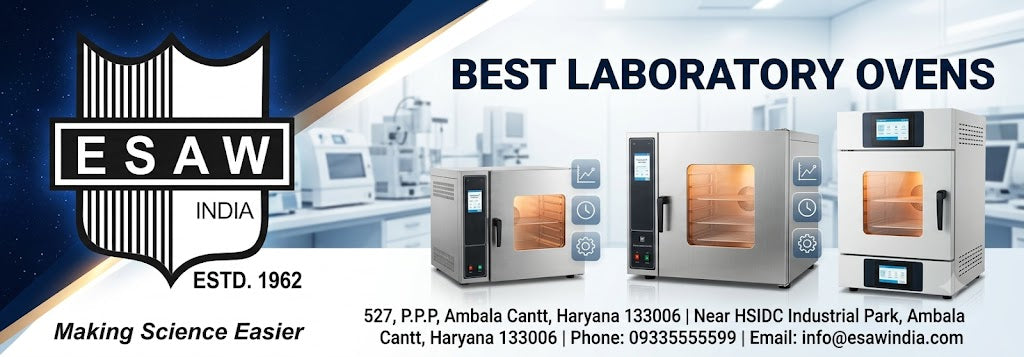
Best Laboratory Ovens | High-Precision Heating by Esaw India
by Akash Dhawan
In industrial testing, material synthesis, and pharmaceutical research, controlling temperature is just as critical as measuring volume or weight. Many processes—such as moisture removal, glassware sterilization, component aging, and high-temp curing—rely entirely on precise environmental stability. Unlike standard domestic baking units that experience dramatic internal temperature shifts, scientific thermal chambers must provide completely uniform heat distribution. For research facilities, quality assurance departments, and educational labs, achieving this level of control requires selecting the Best Laboratory Ovens.
As strict international regulatory frameworks demand perfect batch traceability and precise processing conditions, legacy heating systems are no longer viable. Esaw India, a leading pioneer in scientific manufacturing and instrumentation since 1962, engineers high-performance thermal solutions that match strict structural safety laws. This in-depth informational guide breaks down the core heating technologies, structural classifications, and technical parameters institutional buyers must check to secure the Best Laboratory Ovens for their operations.
Heating Dynamics: Forced Air Convection vs. Gravity Convection
To select the ideal thermal chamber for your facility, you must first understand the thermodynamic differences between the two primary heating mechanisms used in modern laboratories.
Gravity (Natural) Convection Ovens
Gravity convection units rely entirely on the natural movement of air. As air passes over the internal heating elements, it warms up, expands, and naturally rises to the top of the chamber. Meanwhile, cooler, denser air sinks to the bottom to be heated in turn. Because this process does not use active fans, it creates zero airflow turbulence inside the unit. This makes gravity convection ovens perfect for processing delicate powders, fine starches, or lightweight biological samples that would otherwise blow around or experience cross-contamination under forced air currents.
Forced Air (Mechanical) Convection Ovens
For applications requiring rapid drying, high turn-around times, and absolute temperature uniformity across multiple shelves, mechanical convection is the gold standard. These units feature integrated, heavy-duty motorized blowers or circulation fans that continuously force heated air through specialized internal ventilation plenums. This active movement breaks down cold air pockets, provides exceptional thermal recovery times after the door is opened, and ensures that every sample receives identical heat exposure regardless of its shelf position.
Technical Taxonomy: Categorizing Specialized Industrial Ovens
A fully functional testing or processing laboratory requires specialized thermal equipment tailored to the chemical properties of different materials.
1. High-Precision Vacuum Ovens
Vacuum ovens are engineered for sensitive chemical processes where drying samples at standard atmospheric pressure could cause thermal degradation, cracking, or surface oxidation. By combining controlled heat with a powerful vacuum pump, these heavy-duty chambers lower the boiling point of moisture or solvents. This allows materials like sensitive pharmaceuticals, electronic microchips, or delicate polymers to dry thoroughly at much lower temperatures without damaging their base structures.
2. High-Temperature Cleanroom Sterilizers
Specifically designed for biotechnology and clinical medical setups, cleanroom laboratory ovens operate at high temperatures (typically up to $250^\circ\text{C}$ or $300^\circ\text{C}$) to depyrogenate and sterilize glass instruments, stainless steel tools, and surgical hardware. They incorporate internal HEPA filtration networks to ensure that the circulating air remains entirely free of airborne particulate matter, protecting high-value instruments from contamination.
Material Engineering: Building for Industrial Longevity
When reviewing the Best Laboratory Ovens, looking past surface styling and examining the raw metallurgy and build quality is essential to securing an instrument that will last for decades.
Corrosion-Resistant Stainless Steel Interiors
The interior chamber of a lab oven is routinely exposed to acidic vapors, moisture outgassing, and intense heat cycles. Premium manufacturers construct internal walls and adjustable shelving plates out of heavy-gauge, mirror-polished SS-304 or SS-316 stainless steel. This high-grade alloy prevents rust formation, stops chemical pitting, and makes decontamination fast and simple.
High-Density Thermal Insulation and Gaskets
To keep the outer body of the machine cool to the touch and protect lab technicians from accidental burns, a thick layer of mineral glass wool or ceramic fiber insulation is packed between the inner chamber and the outer powder-coated mild steel body. Additionally, the door perimeter is lined with a high-temperature, food-grade silicone or fiberglass gasket that creates an airtight seal, preventing energy loss and maintaining stable internal temperatures.
Advanced Microprocessor Controls and Redundant Safety Systems
A premium laboratory oven serves as a protective vault for high-value research assets. Therefore, modern units feature advanced digital safety tracking networks:
-
PID Microprocessor Controllers: Linked to ultra-sensitive RTD Pt-100 sensors, these controllers monitor temperatures to within $\pm0.5^\circ\text{C}$. They dynamically adjust power output to prevent temperature overshooting, saving energy and protecting delicate samples.
-
Independent Over-Temperature Protection: This mechanical safety backup cuts off power to the heating elements automatically if the primary controller fails. This prevents thermal runaway, protecting your laboratory from potential fire hazards.
Conclusion: Partnering with Esaw India for Thermal Excellence
Securing consistent batch data, preserving material purity, and maintaining high processing safety relies heavily on your choice of heating equipment. Sourcing your instruments directly from an established domestic manufacturer-supplier like Esaw India guarantees your lab benefits from over sixty years of production heritage, factory-direct cost efficiency, and precise calibration support. Your search for the Best Laboratory Ovens ends with a commitment to absolute thermodynamic stability and rugged durability.
Equip your testing facilities, industrial plants, and research universities with instruments designed for lifelong calibration and uncompromised safety. Partner with Esaw India and bring world-class thermal precision to your scientific infrastructure today.
Leave a comment