New customers save 5% with the code GET05

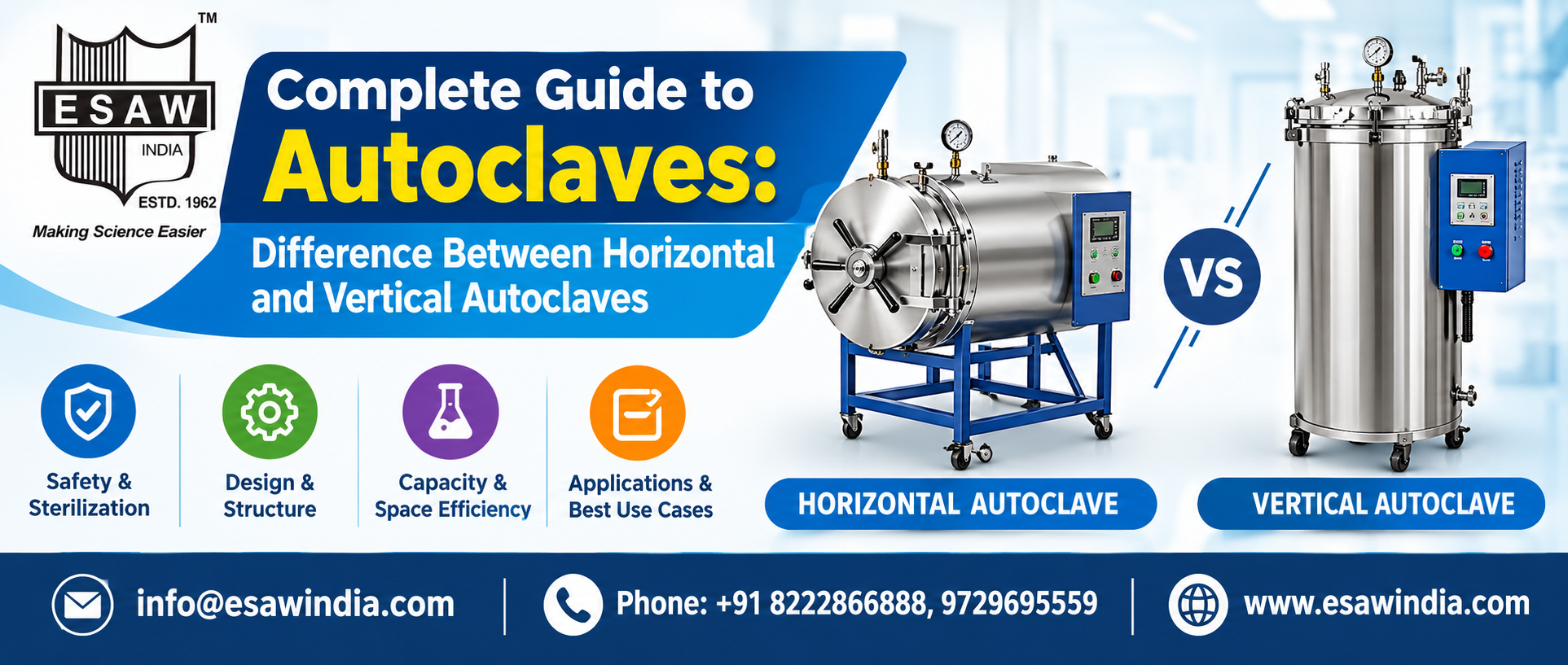
Complete Guide to Autoclaves: Difference Between Horizontal and Vertical Autoclaves
Sterilization is a non-negotiable process across medical facilities, pharmaceutical manufacturing plants, microbiology laboratories, research institutes, and industrial food processing units. At the core of reliable sterilization technology is the steam sterilizer, commonly known as laboratory autoclaves. By utilizing high-pressure saturated steam, autoclaves destroy bacteria, viruses, fungi, and spores from equipment and media.
When selecting an autoclave for your facility, one of the most fundamental structural choices you will face is deciding between horizontal autoclaves and vertical autoclaves. While both operate on similar thermodynamic principles, their physical architecture, loading mechanisms, capacity limits, ergonomic impact, and ideal applications differ significantly.
This comprehensive guide breaks down the critical differences between horizontal and vertical autoclaves, explores key buying factors, pricing dynamics, leading industry standards, and provides direct answers to common procurement questions.
What is a Horizontal Autoclave?

A horizontal autoclave features a chamber oriented horizontally, requiring items to be loaded from the front through a hinged or sliding door. Because the loading plane is parallel to the ground, horizontal autoclaves can accommodate heavy, bulky, or standardized modular tray systems (such as ISO trays and basket racks).
Key Characteristics of Horizontal Autoclaves
- Front-Loading Design: Allows effortless sliding of heavy instrument trays, carts, or large media bottles directly into the chamber.
- Rectangular or Cylindrical Chambers: Available in both shapes, with rectangular chambers maximizing internal volume utilization.
- Higher Volume Capacity: Typically ranges from 100 liters to over 5,000+ liters, making them essential for industrial and hospital-scale operations.
- Advanced Cycle Controls: Often equipped with pre-vacuum (prevac) and post-vacuum drying cycles, jacket heating, and effluent decontamination features.
What is a Vertical Autoclave?
A vertical autoclave (frequently called a top-loading autoclave) features a chamber oriented vertically, where materials are loaded from the top down into the sterilizing vessel. Users open the top lid and lower wire baskets or buckets containing the load into the deep cylindrical chamber.
Key Characteristics of Vertical Autoclaves
- Top-Loading Architecture: Reduces the physical footprint required on laboratory floors.
- Cylindrical Chamber Geometry: Standard design that handles pressure distribution efficiently with minimal wall thickness.
- Compact Footprint: Ideal for facilities where floor space is limited or restricted.
- Smaller to Medium Volume Capacity: Generally spans between 20 liters and 150 liters.
Detailed Comparison: Horizontal vs. Vertical Autoclaves
To make an informed purchasing decision, it is vital to evaluate how these two equipment designs compare across key functional dimensions:
| Comparison Parameter | Horizontal Autoclave | Vertical Autoclave |
|---|---|---|
| Loading Style | Front-loading (horizontal tray/cart sliding) | Top-loading (lowering baskets from above) |
| Footprint Requirements | Larger floor footprint + front door clearance space | Compact floor footprint; fits in tight lab spaces |
| Capacity Range | 100 Liters to 5,000+ Liters | 20 Liters to 150 Liters |
| Chamber Geometry | Rectangular or Cylindrical | Almost exclusively Cylindrical |
| Ergonomics | Easy chest-level or cart-level loading; lower lifting strain | Requires lifting loads vertically over the top lid |
| Drying Capabilities | High-efficiency vacuum drying with heated jackets | Gravity displacement with thermal or forced air drying |
| Primary Applications | CSSD hospitals, pharma manufacturing, large research labs | Microbiology labs, tissue culture, mushroom cultivation, small clinics |
| Capital Investment | Higher initial cost and utility installation costs | Lower capital cost and simple utility hookups |
In-Depth Structural and Operational Differences

1. Ergonomics and Material Handling
- Horizontal Models: Front-loading autoclaves excel in high-throughput environments. Facilities utilizing transfer carts can roll loaded baskets directly from washing stations into the chamber without manual lifting. This dramatically reduces ergonomic strain and workplace injury risks when processing heavy surgical sets or large liquid volumes.
- Vertical Models: Top-loading autoclaves require operators to lift sterilizing baskets vertically over the rim and lower them inside. While convenient for lightweight items or small liquid flasks, handling heavy metal containers vertically can be physically demanding.
2. Vacuum and Drying Performance
- Horizontal Models: Typically equipped with powerful liquid-ring vacuum pumps. Steam is injected after multiple vacuum pulses remove trapped air from porous goods, wrapped surgical packs, and narrow tubing. Post-sterilization vacuum drying ensures items emerge completely dry and ready for immediate storage or sterile deployment.
- Vertical Models: Primarily rely on gravity air displacement, where incoming steam forces cooler, denser air out through an exhaust valve at the bottom. While ideal for culture media, glassware, and unwrapped solid instruments, vertical units usually provide basic thermal drying rather than high-performance deep vacuum drying.
3. Space Utilization and Facility Integration
- Horizontal Models: Require dedicated utility connections (such as pure steam lines, chilled water returns, floor drains, and high-voltage three-phase power). They also demand front clearance for door opening and service access panels on the side or rear.
- Vertical Models: Built for plug-and-play operation in smaller facilities. Many models operate on standard single-phase power, feature built-in water reservoirs, and emit exhaust into condensed collection bottles, eliminating the need for complex plumbing.
Industry Applications & Best Use Cases
When to Choose a Horizontal Autoclave
- Central Sterile Supply Departments (CSSD): Hospitals require hospital grade horizontal autoclave manufacturers to supply multi-door pass-through sterilizers that connect contaminated receiving areas to clean sterile assembly zones.
- Pharmaceutical Manufacturing: Biopharmaceutical cleanrooms demand double-door horizontal steam sterilizers featuring validation-grade control systems, sanitary piping, and full compliance with cGMP and 21 CFR Part 11 standards.
- High-Volume Research Facilities: Facilities processing hundreds of liters of growth media, animal cages, or bulk waste daily depend on industrial-scale horizontal chambers.
When to Choose a Vertical Autoclave
- Microbiology & Life Science Laboratories: Ideal for sterilizing agar plates, nutrient broth, liquid waste, and lab glassware.
- Plant Tissue Culture & Mushroom Cultivation: Small-to-medium growers and micro-propagation labs rely on vertical units for substrate and media preparation.
- Educational & Diagnostic Clinics: Universities, veterinary clinics, and small medical centers benefit from low cost of entry, minimal footprint, and straightforward operation.
Procurement & Buying Guide
Finding a reliable horizontal autoclave for sale or selecting cylindrical vertical autoclave suppliers requires careful technical evaluation before placing an order.
Essential Factors to Evaluate Before Purchasing:
- Chamber Volume & Load Type: Calculate your peak daily sterilization volume. Are you sterilizing wrapped surgical packs, liquid bottles, waste bags, or un-wrapped instruments?
- Steam Source: Determine whether your facility provides clean steam from an external boiler or if the autoclave needs a built-in steam generator.
- Material Quality: Ensure the pressure vessel is constructed from high-grade stainless steel (304, 316, or 316L) to resist corrosion and thermal fatigue.
- Regulatory Standards: Check for local and international pressure vessel certifications, such as ASME Code Stamp, PED (Pressure Equipment Directive), ISO 13485, and CE mark.
- Automation & Safety Doors: Modern autoclaves should include automatic safety interlocks that prevent door opening while the chamber remains pressurized or at elevated temperatures.
Market Price Expectations: Industrial & Commercial Models
Autoclave pricing varies substantially based on chamber size, materials of construction, vacuum capability, automation levels, and regulatory compliance packages.

Industrial Horizontal Autoclave Price Trends
- Compact / Benchtop Horizontal Autoclaves (20L – 60L)
- Standard Laboratory Horizontal Autoclaves (100L – 300L)
- Hospital CSSD & Pharma-Grade Horizontal Autoclaves (400L – 2000L+)
Vertical Autoclave Price Trends
- Standard Semi-Automatic Vertical Autoclaves (35L – 75L)
- Microprocessor-Controlled Vertical Autoclaves (75L – 150L)
- Advanced Fully Automatic Vertical Steam Sterilizers
Note: Actual prices depend heavily on custom accessories, air filtration units, validation documentation (IQ/OQ/PQ protocols), and localized shipping or installation fees.
Maintenance and Safety Best Practices
To maximize the operational lifespan and safety of your steam sterilizer:
- Daily Water Quality Checks: Use distilled or demineralized water to prevent mineral scale buildup on heating elements and internal pipework.
- Door Gasket Inspection: Inspect silicone or fluoroelastomer door seals daily for cracks, tears, or debris buildup to maintain pressure tightness.
- Biological & Chemical Monitoring: Regularly run chemical indicator strips and biological spore tests (such as Geobacillus stearothermophilus) to verify complete sterilization efficacy.
- Annual Safety Valve Calibration: Schedule certified technicians to inspect and calibrate safety relief valves, pressure transmitters, and temperature sensors.
Frequently Asked Questions:
What is the main difference between horizontal and vertical autoclaves?
The primary difference is chamber orientation and loading style. Horizontal autoclaves load horizontally from the front, making them suitable for heavy trays, carts, and large volume capacities. Vertical autoclaves load vertically from the top, making them compact and ideal for smaller lab spaces with light to moderate throughput needs.
What factors influence the industrial horizontal autoclave price?
Key factors include chamber volume capacity, vessel material (such as 316L stainless steel), inclusion of an internal steam generator, vacuum pump specifications, double-door pass-through designs, software features (like 21 CFR Part 11 audit trails), and pressure vessel certification standards.
To establish strong search authority across both traditional search engines and AI-driven platforms, your content must seamlessly integrate target keywords into direct, solution-oriented answers. Buyers searching for a vertical autoclave price in India or looking for a top loading vertical autoclave for sale are typically educational institutions, microbiology labs, and research facilities that prioritize compact design and cost-efficiency. On the other hand, commercial clients seeking a large capacity horizontal steam sterilizer or comparing industrial horizontal autoclave price options are generally CSSD hospital departments and pharmaceutical units looking for high-throughput solutions.
Need Expert Advice or Price Quote?


Leave a comment