New customers save 5% with the code GET05

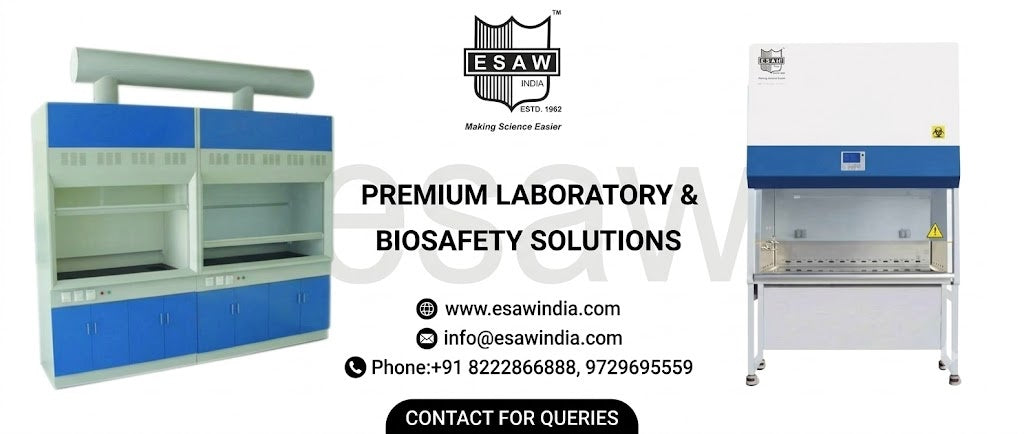
Certified Biosafety Cabinet Manufacturers & Wholesalers | Lab Cabinets by ESAW INDIA
In modern biological research, clinical diagnostics, pharmaceutical manufacturing, and biotechnology laboratories, biosafety is paramount. Working with infectious agents, dangerous pathogens, cell cultures, and sensitive chemical compounds requires reliable biological containment systems. This is where high-quality biological safety equipment from trusted industry pioneers like ESAW INDIA comes into play.
When selecting biological safety containment solutions, lab managers, procurement officers, and researchers face critical decisions. Partnering with reputable biosafety cabinet manufacturers, biosafety cabinet suppliers, and Biosafety cabinet wholesalers like ESAW INDIA ensures access to certified equipment that protects lab technicians, experimental materials, and the surrounding environment.
This comprehensive guide explores the fundamentals of biosafety cabinets, focusing on key classifications, including the popular vertical laminar flow biosafety cabinet, essential safety certifications, and strategies for sourcing high-grade equipment at wholesale prices.
What is a Biosafety Cabinet?
A Biosafety Cabinet (BSC)—also known as a biological safety cabinet or microbiological safety cabinet—is an enclosed, ventilated laboratory workspace designed to offer protection to the operator, the environment, and the product being handled.
Unlike standard clean benches or simple laminar flow hoods that only protect the sample on the work surface, a true certified biosafety cabinet engineered by ESAW INDIA utilizes High-Efficiency Particulate Air (HEPA) or Ultra-Low Penetration Air (ULPA) filtration to capture dangerous airborne particulates, bacteria, and viruses before air is recirculated or exhausted into the facility.

The Three Core Levels of Protection
A high-grade biosafety cabinet manufactured by ESAW INDIA is engineered to deliver up to three distinct levels of protection:
- Personnel Protection: Prevents researchers from inhaling hazardous aerosols generated during pipetting, vortexing, or centrifuging pathogenic materials.
- Product / Sample Protection: Prevents external contaminants from entering the work area, keeping cell cultures, tissue samples, and sterile formulations pure.
- Environmental Protection: Filters exhaust air to prevent infectious agents or toxins from escaping into the surrounding laboratory atmosphere or outdoor environment.
Looking for Certified Bio Safety Cabinets for Your Lab?
Get high-grade protection with ESAW INDIA's industry-leading biological containment systems.
Enquire Now for Best PriceBiosafety Cabinet Classifications Explained
Understanding the differences between cabinet classifications is essential when consulting biosafety cabinet manufacturers like ESAW INDIA to select the ideal model for your specific Biosafety Level (BSL-1, BSL-2, BSL-3, or BSL-4) setting.
Biosafety Cabinet Hierarchy
       +-------------------------------------------------------+
       |               Biosafety Cabinet Classes               |
       +-------------------------------------------------------+
                                   |
       +---------------------------+---------------------------+
       |                           |                           |
  [ Class I ]                 [ Class II ]                [ Class III ]
  - Personnel &               - Personnel, Product,       - Total Enclosure
    Environment Protection      & Environment Protection  - Maximum Protection
  - No Product Protection     - Types A1, A2, B1, B2      - BSL-4 Facilities
1. Class I Biosafety Cabinets
Class I cabinets provide personnel and environmental protection but do not protect the sample or product from room air contamination. Unfiltered room air enters through the front opening, passes over the work surface, and is filtered via HEPA filters before being exhausted. These cabinets are typically used for housing equipment like centrifuges or for handling non-sterile low-to-moderate risk agents.
2. Class II Biosafety Cabinets
Class II Biosafety cabinets are the most widely used biological safety enclosures across clinical, medical, research, and industrial settings. ESAW INDIA manufactures an extensive lineup of Class II cabinets that provide full personnel, product, and environmental protection.
Class II cabinets are subdivided into four main types based on airflow design, construction, and exhaust mechanisms:
- Class II, Type A1 & A2: Recirculate a significant portion (roughly 70%) of HEPA-filtered air within the cabinet while exhausting 30% through HEPA filters back into the lab or through facility ductwork.
- Class II, Type B1 & B2: Designed for handling materials with trace amounts of volatile chemicals or radionuclides. Type B2 cabinets from ESAW INDIA are total-exhaust units (100% hard-ducted outside), ensuring zero recirculation within the workspace.
3. Class III Biosafety Cabinets
Class III cabinets are gas-tight, completely sealed enclosures engineered for high-containment Biosafety Level 4 (BSL-4) facilities dealing with lethal human pathogens (such as Ebola or Marburg viruses). Work is conducted using heavy-duty rubber gloves attached to the cabinet body, and intake/exhaust air is double-HEPA filtered.
Spotlight on Vertical Laminar Flow Biosafety Cabinets by ESAW INDIA
One of the most frequently requested configurations from leading biosafety cabinet manufacturers like ESAW INDIA is the vertical laminar flow biosafety cabinet.
How Vertical Laminar Flow Works
Laminar flow refers to air moving at a continuous, uniform velocity in parallel lines without turbulence. In an ESAW INDIA vertical laminar flow biosafety cabinet, HEPA-filtered air is pushed downward from the top of the cabinet casing vertically onto the work surface before being pulled through grilles at the front and back of the cabinet floor.
Vertical Laminar Airflow Mechanism
                  [ Top Fan / Filter Unit ]
                             |
                             v
               ||||||||||||||||||||||||||
               |  HEPA Filter Matrix    |
               ||||||||||||||||||||||||||
                             |
                             v  (Vertical Downward Airflow)
               +------------------------+
               |        Work Area       |
               +------------------------+
               | [Grille]      [Grille] |
                             |
                             v
                  [ Recirculation / Exhaust ]
Advantages of Vertical Laminar Flow Cabinets by ESAW INDIA
- Uniform Product Protection: Downward airflow creates a continuous blanket of sterile air over samples, preventing cross-contamination between specimens placed on the work area.
- Ergonomic Design: ESAW INDIA designs vertical airflow configurations with deeper work zones and larger front openings, providing greater visibility and physical comfort for laboratory technicians working extended shifts.
- Space Efficiency: Vertical flow cabinets often occupy a smaller floor or bench footprint compared to horizontal flow clean benches.
Key Industry Standards and Certifications
When evaluating certified lab cabinets offered by Biosafety cabinet wholesalers or distributors, verifying compliance with international quality standards is critical for compliance and safety audits. ESAW INDIA manufactures products built in compliance with globally recognized standard benchmarks:
| Standard / Certification | Region / Scope | Key Requirement |
|---|---|---|
| NSF/ANSI 49 | North America & Global | Gold standard for Class II biosafety cabinet construction, performance, and field testing. |
| EN 12469 | Europe | European performance criteria for microbiological safety cabinets. |
| ISO 14644-1 | International | Cleanroom air cleanliness classification (typically Class 5 / Class 100 air quality). |
| CE Mark | Europe | Compliance with health, safety, and environmental protection standards. |
| UL / CSA Listing | North America | Electrical safety and mechanical compliance certification. |
Buying non-certified or unverified cabinets compromises safety and can lead to costly regulatory compliance failures or unsafe contamination events.
Why Choose ESAW INDIA as Your Biosafety Cabinet Manufacturer & Supplier
Selecting the right manufacturing partner is essential. Whether purchasing a single unit or outfitting a multi-story research facility, ESAW INDIA stands out among top biosafety cabinet suppliers due to:

1. Engineering Precision & High-Grade HEPA/ULPA Filtration
ESAW INDIA utilizes premium HEPA and ULPA filters engineered to capture at least 99.97% to 99.999% of airborne particles down to 0.3 microns (or 0.12 microns for ULPA). Models feature microprocessor-controlled airflow speed monitors, real-time pressure sensors, and filter lifespan indicators.
2. Robust Construction & Ergonomic Build
ESAW INDIA cabinets utilize 304 or 316 stainless steel interior work chambers that resist corrosion, chemical spills, and heavy disinfectant wipe-downs. Units include angled front sash windows, anti-glare safety glass, LED illumination, and adjustable stand heights to minimize operator strain.
3. Comprehensive Support from Biosafety Cabinet Wholesalers
As premier Biosafety cabinet wholesalers and manufacturers, ESAW INDIA provides bulk order fulfillment, direct factory warranties, readily available spare parts, and expert field guidance to ensure your lab equipment meets all initial and annual field re-certifications.
Essential Maintenance Practices for Biosafety Cabinets
To maintain optimal containment performance and protect your investment over its lifespan, adhere to these routine maintenance protocols:
- Daily Operational Checks: Verify airflow velocity indicators and static pressure gauges before beginning work. Ensure the sash window is positioned at the certified working height.
- Proper Work Protocols: Do not block front or rear intake grilles with elbows, notebooks, or equipment. Operate at least 4 inches inside the front sash.
- Decontamination & Disinfection: Clean internal surfaces with appropriate disinfectants (such as 70% ethanol or validated non-corrosive agents) before and after every work session.
- Annual Certification: Schedule annual field testing by certified technicians to verify filter integrity, face velocity, and cabinet containment integrity according to NSF 49 or EN 12469 guidelines.
Frequently Asked Questions (FAQ)
Q1: What is the main difference between a laminar flow hood and a Biosafety Cabinet?
A standard laminar flow hood only provides product protection by blowing filtered air across the work surface toward the operator. It does not protect the user from biological hazards. In contrast, a certified Biosafety Cabinet engineered by ESAW INDIA provides personnel, environmental, and product protection through negative air pressure dynamic barriers and HEPA exhaust filtration.
Q2: Why choose a vertical laminar flow biosafety cabinet over horizontal flow models?
A vertical laminar flow biosafety cabinet directs sterile air downward, which reduces direct air turbulence toward the operator’s face and allows for a larger, deeper workspace. It is particularly ideal for operations involving hazardous biological substances where personnel safety is as important as product sterility.
Q3: How do I select the right biosafety cabinet manufacturers or suppliers for my laboratory?
When evaluating biosafety cabinet suppliers, look for companies like ESAW INDIA that offer internationally recognized certifications (such as ISO, CE, and compliance with NSF/ANSI 49 or EN 12469 standards), comprehensive warranty coverage, readily available replacement filters, and robust technical support.
Q4: Can I purchase biosafety cabinets in bulk directly from a Biosafety cabinet wholesaler?
Yes. Sourcing equipment directly from a reputable Biosafety cabinet wholesaler like ESAW INDIA allows research institutions, universities, medical centers, and distributor partners to secure competitive wholesale pricing, custom dimensional modifications, and streamlined logistical support for large-scale lab setups.
Q5: How often should a biosafety cabinet HEPA filter be replaced?
Under standard laboratory operating conditions, a HEPA filter in an ESAW INDIA biosafety cabinet typically lasts between 3 to 5 years. However, filter longevity depends heavily on ambient air cleanliness, daily usage hours, and regular pre-filter maintenance. Annual certification testing will indicate when pressure differentials necessitate a filter replacement.
Conclusion
A certified Biosafety Cabinet is a fundamental line of defense in modern biological laboratories. Whether you require a standard Class II unit or a specialized vertical laminar flow biosafety cabinet, selecting high-performance, fully certified equipment from ESAW INDIA protects your personnel, your samples, and the community.
Partnering with established biosafety cabinet manufacturers, reliable biosafety cabinet suppliers, and trusted Biosafety cabinet wholesalers like ESAW INDIA ensures you receive industry-compliant lab cabinets backed by robust warranties, safety certifications, and expert technical support. Inspect specifications carefully, confirm compliance, and invest in biological safety solutions engineered to protect your critical research.
Ready to Upgrade Your Laboratory Safety?
Contact ESAW INDIA today for custom specifications, technical consultation, and wholesale pricing.
Enquire Now / Request A Quote


Leave a comment