New customers save 5% with the code GET05

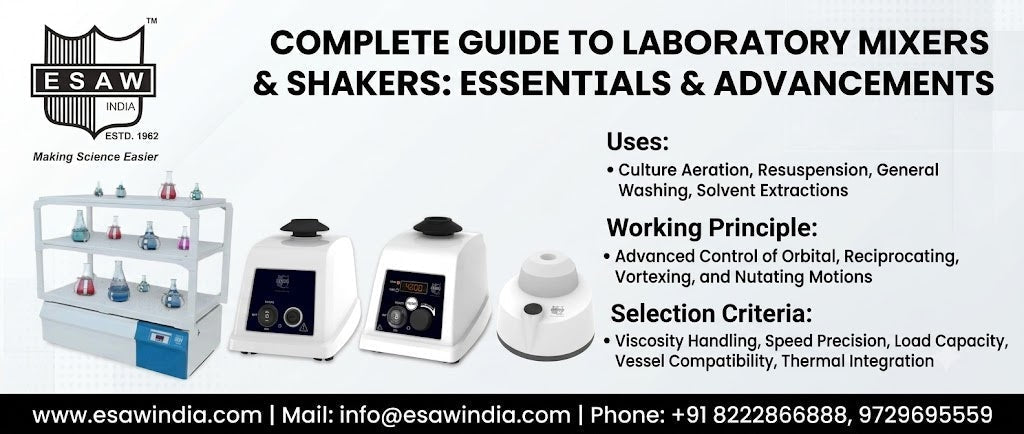
Laboratory Mixers and Shakers: Uses, Working Principle, and Selection Criteria
ESAW India Laboratory mixing equipment is fundamental to biological, chemical, pharmaceutical, and industrial research. Understanding the core functions, design variations, and exact working mechanisms of these instruments ensures experimental accuracy, sample safety, and reliable sourcing from a trusted Laboratory Shaker Manufacturer and Supplier.

What are Laboratory Mixers and Shakers?
A laboratory mixer and shaker is a specialized precision device designed to combine, homogenize, emulsify, suspend, or agitate liquid and solid-liquid samples inside containers such as test tubes, flasks, beakers, and microplates.
Modern scientific procedures demand specific agitation patterns—ranging from high-speed vortexing to gentle rotational tilting. Choosing the right laboratory mixer and shaker depends directly on sample viscosity, vessel geometry, required speed (RPM), and thermal sensitivity.
+-----------------------------------------------------------------------------------+
|                        LABORATORY MIXING EQUIPMENT SPECTRUM                      |
+-----------------------------------------------------------------------------------+
|  HIGH VISCOSITY / SHEAR   |    MEDIUM VISCOSITY / AGITATION  | GENTLE / SENSITIVE |
+---------------------------+----------------------------------+--------------------+
| • Overhead Stirrers       | • Orbital Shakers                | • Rocking Shakers  |
| • Lab Homogenizers        | • Reciprocating Shakers          | • 3D Rotators      |
| • High-Speed Vortexing    | • Magnetic Stirrers              | • Nutating Mixers  |
+-----------------------------------------------------------------------------------+
Primary Uses of Laboratory Mixers and Shakers
The operational application of an Orbital Shaker for Laboratory Use spans multiple technical fields:
- Microbiology and Cell Culture: Orbital and incubator shakers maintain cell suspensions in optimal motion, enabling uniform oxygen transfer and nutrient absorption without damaging cell membranes.
- Chemical Synthesis and Dissolution: Magnetic stirrers and overhead stirrers rapidly dissolve solids into solvent matrixes and maintain homogeneous chemical reactions.
- Molecular Biology and Diagnostics: Vortex laboratory mixers rapidly resuspend cell pellets, mix PCR reagents, and disperse dense enzyme solutions.
- Pharmaceutical and Cosmetic Formulation: High-shear homogenizers and heavy-duty mixers prepare stable emulsions, creams, and suspensions.
- Environmental and Soil Testing: Reciprocating shakers provide intense linear motion for chemical extraction procedures, such as TCLP (Toxicity Characteristic Leaching Procedure).
Working Principles of Main Laboratory Mixers and Shakers
Different types of Lab Stirrers and Mixers Online utilize distinct mechanical principles to achieve sample uniformity.

  1. ORBITAL SHAKER                 2. VORTEX MIXER                   3. OVERHEAD STIRRER
  [Circular Plane Motion]          [Eccentric Off-Center Orbit]     [Direct Shaft Driven]
       ┌──────────┐                     ┌──────────┐                     ┌──────────┐
       │ ↺  ↺  ↺ │                     │  ( 🌀 )  │                     │    ││    │
       └──────────┘                     └────┬─────┘                     └────┼─────┘
  (Smooth Circular Mixing)           (High-Speed Vortex)              (Direct Viscous Impeller)
1. Orbital Shakers
- Working Principle: An Orbital and 3D Shaker generates a continuous, smooth circular motion in a horizontal plane. Driven by an eccentric counterbalance mechanism linked to a brushless DC motor, it creates a swirling fluid vortex inside open or stoppered vessels.
- Key Use Case: Ideal for aeration of bacterial cultures, tissue culture growth, and general washing procedures.
2. Vortex Mixers
- Working Principle: A vortex-type laboratory mixer and shaker relies on a drive shaft connected to an off-center orbital mechanism. When a test tube or small vessel is pressed onto the rubber cup, the rapid high-speed eccentric rotation (up to 3000 RPM) creates a vertical liquid vortex.
- Key Use Case: Instant mixing of small liquid volumes in microcentrifuge tubes, test tubes, and microplates.
3. Magnetic Stirrers and Hotplate Stirrers
- Working Principle: This laboratory mixer and shaker variant uses a rotating magnetic field generated by stationary electromagnets or a rotating permanent magnet under the top plate. A PTFE-coated magnetic stir bar placed inside the liquid spins synchronously with the magnetic field.
- Key Use Case: Low-to-medium viscosity chemical mixing, buffer preparation, and simultaneous liquid heating.
4. Overhead Stirrers
- Working Principle: An overhead laboratory mixer and shaker utilizes a high-torque motor mounted above the sample vessel, driving an impeller blade immersed directly in the fluid. Smart electronic feedback maintains constant speed even as liquid viscosity changes.
- Key Use Case: High-viscosity mixing (gels, polymers, heavy oils, slurries) and large batch fluid processing.
5. Reciprocating and Rocking Shakers
- Working Principle: A reciprocating laboratory mixer and shaker drives back-and-forth linear agitation, while a rocking shaker utilizes a back-and-forth tilting platform (typically 3° to 12° angle) to create gentle wave mixing.
- Key Use Case: Gel staining/destaining, Western blotting, and intense solvent extraction protocols.
Featured Laboratory Mixers & Shakers
Explore popular precision models from ESAW India:
Single Tier Orbital Shaker
Ideal for smooth horizontal mixing and biological culture growth.
View ProductPlastic Body Mini Vortex Mixer
Compact high-speed vortex mixer for quick sample agitation.
View ProductTechnical Comparison Table
| Equipment Type | Motion Type | Speed Range (RPM) | Best Suitable For | Typical Vessel Types |
|---|---|---|---|---|
| Orbital Shaker | Circular horizontal orbit | 30 – 500 RPM | Cell cultures, microbiology | Erlenmeyer flasks, microtiter plates |
| Vortex Mixer | High-speed eccentric orbital | 200 – 3000 RPM | Rapid fluid homogenization | Test tubes, PCR tubes, microtubes |
| Magnetic Stirrer | Magnetic field rotation | 100 – 1500 RPM | General chemical solutions, buffers | Beakers, flat-bottom flasks |
| Overhead Stirrer | Direct mechanical impeller drive | 50 – 2000 RPM | Viscous liquids, resins, polymers | Open jars, heavy reaction vessels |
| Rocking Shaker | See-saw tilting movement | 5 – 80 RPM | Sensitive blots, gel washing | Trays, flat culture boxes |
Key Considerations when Selecting Laboratory Mixers and Shakers
Selecting the optimal laboratory mixer and shaker requires evaluating technical parameters against your protocol requirements:
- Viscosity Handling Capability: Low viscosity liquids (water-like fluids) require magnetic stirrers or orbital shakers. High viscosity materials (oils, creams, resins) demand direct-drive overhead stirrers with high motor torque.
- Speed Precision and Control: Digital microprocessor controls ensure precise RPM accuracy, preventing sample overflow or shear damage to biological cells.
- Load Capacity and Vessel Compatibility: Verify the maximum platform weight limit and clamp attachments to ensure compatibility with your flask sizes and multi-well plates.
- Thermal Integration: If your procedure requires controlled temperatures, choose an incubator-shaker or a heating magnetic stirrer with external probe connectivity.

Key Thoughts on Laboratory Mixers and Shakers
When integrating a laboratory mixer and shaker into a scientific workflow, focus on instrument stability, safety mechanisms (such as over-torque protection and smooth start features), and long-term motor reliability. Matching the correct motion profile—whether orbital, linear, vortexing, or high-shear stirring—guarantees sample integrity, optimizes reaction kinetics, and ensures reliable analytical results across all research applications.
Need Expert Assistance with Lab Equipment?
Get direct support, custom quotes, and wholesale pricing from India's trusted lab equipment manufacturer.
Frequently Asked Questions
What is the main difference between a laboratory mixer and a laboratory shaker?
A laboratory vortex mixer uses external platform motion (orbital, linear, or tilting) or high-speed localized force to agitate liquids inside containers. A laboratory shaker uses platform agitation, while mixers and stirrers often utilize internal mechanisms (magnetic stir bars or impellers) to blend samples directly.
How do I choose between an orbital shaker and a reciprocating shaker?
Choose an orbital shaker for gentle, continuous swirling motion ideal for cell growth and aeration in round flasks. Choose a reciprocating shaker for aggressive back-and-forth linear mixing, which is necessary for solvent extractions and separatory funnel shaking.
Can a magnetic stirrer handle high-viscosity liquids?
No, standard magnetic stirrers are designed for low-to-medium viscosity fluids. High-viscosity liquids reduce stir bar coupling, causing magnetic decoupling (de-syncing). Use a high-torque overhead stirrer for viscous samples like pastes, heavy oils, or polymers.
Why is speed control critical in a vortex laboratory mixer and shaker?
Speed control prevents sample splashing, tube rupture, and fluid overflow. Adjustable RPM allows researchers to switch from gentle mixing of sensitive biological samples to aggressive resuspension of dense bacterial cell pellets.
Key Takeaways
Choosing the right laboratory mixer and shaker is pivotal to achieving experimental consistency, procedural accuracy, and long-term operational efficiency in modern scientific and industrial environments. Whether your laboratory focuses on cell culture growth, chemical synthesis, molecular diagnostics, or high-viscosity product formulation, matching the correct motion dynamics—orbital, linear, magnetic, or mechanical direct-drive—directly impacts your analytical results. A well-selected Orbital Shaker for Laboratory Use eliminates sample variability, reduces human error, and ensures the structural integrity of sensitive biological cells and chemical compounds.
As scientific procedures advance and automation becomes standard, modern equipment units offer enhanced digital microprocessor controls, programmable speed sequences, and integrated thermal management. These features allow research teams to maintain strict protocol compliance and complete reproducibility across every batch. Investing in high-performance equipment with built-in safety mechanisms, such as over-torque protection and smooth acceleration, protects both your delicate samples and valuable laboratory personnel.
Ultimately, evaluating your specific laboratory requirements—including sample viscosity, vessel compatibility, load capacity, and operational speed ranges—enables you to select a reliable laboratory mixer and shaker tailored to your workflow. By prioritizing mechanical durability, precision speed adjustment, and versatile platform attachments, laboratories can optimize reaction kinetics, maximize daily throughput, and establish a solid foundation for groundbreaking research and quality assurance.
Precision, Efficiency, Reliability




Leave a comment