New customers save 5% with the code GET05




In today’s rapidly advancing scientific and industrial landscape, precise optics and dependable laboratory instruments are essential. From medical diagnostics and scientific research to university laboratories and industrial quality control, high-performance microscopes play a pivotal role. As global demand for high-precision optical equipment grows, India has established itself as an international hub for manufacturing and exporting world-class optical instruments.
If you are seeking a top 10 microscope manufacturer and exporter in India, understanding quality standards, product diversity, manufacturing capabilities, and export compliance is vital. This guide provides a detailed overview of what makes Indian optical manufacturers leaders in the global market and how to select the right partner for your laboratory needs.
Why India is a Global Hub for Microscope Manufacturing
India's optical instrument industry—particularly centered in manufacturing hubs like Ambala, Haryana—has earned a global reputation for combining advanced precision engineering with cost-effective production.
Key advantages of sourcing microscopes from top Indian exporters include:
- Superior Optical Precision: Advanced anti-reflective coatings, high-grade glass optics, and ergonomic mechanical designs ensure crisp images and durable operation.
- Cost Efficiency: Competitive production costs allow international buyers to import high-specification research and educational microscopes at optimal price points.
- Strict Quality Control: Leading manufacturers adhere to international quality frameworks, including ISO 9001, ISO 13485, and CE certifications.
- Global Shipping Infrastructure: Established exporters have seamless international logistics, secure packaging protocols, and customs expertise to deliver products safely worldwide.
Need Bulk Microscope Pricing or Custom Specifications?
Get direct factory quotes and exporter catalogs tailored to your requirements.
Send Direct InquiryTop 10 Types of Microscopes Offered by Indian Exporters
When evaluating product catalogs from leading Indian suppliers, you will find a broad array of instruments tailored to specific scientific, medical, and educational applications.
1. Biological Microscopes
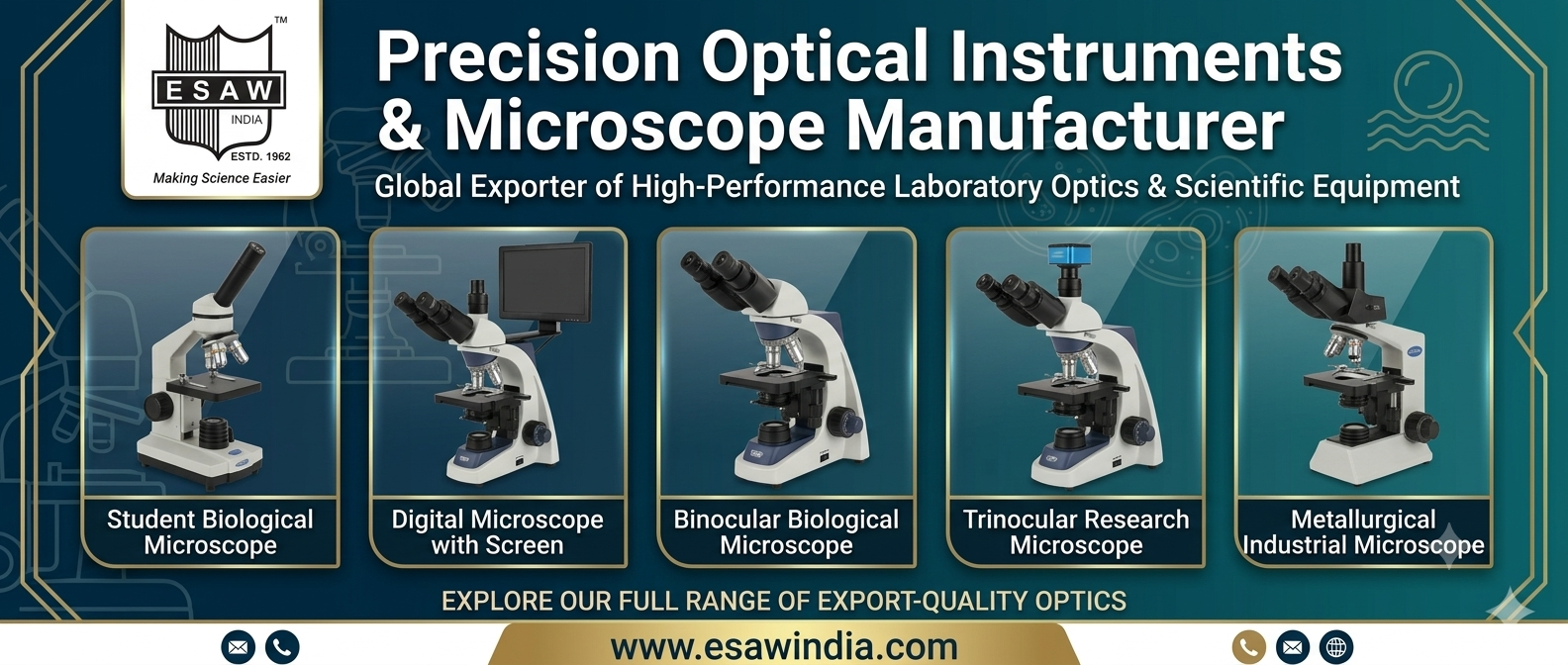
Designed for biological research, medical diagnostics, and educational institutions. These instruments come in monocular, binocular, and trinocular configurations, equipped with high-contrast achromatic or plan-achromatic objectives.
2. Stereo & Dissecting Microscopes
Ideal for 3D observation, specimen dissection, circuit board inspection, and material analysis. Stereo zoom microscopes provide continuous magnification and excellent depth perception.
3. Metallurgical & Industrial Microscopes
Engineered for material science, quality assurance, and metallurgy. They utilize reflected light illumination to analyze opaque materials, metals, alloys, and composite structures.
4. Polarizing Microscopes
Essential for geology, mineralogy, and pharmacology. These systems analyze birefringent materials using polarized light to identify crystalline structures.
5. Digital & Fluorescence Microscopes
Equipped with high-resolution digital cameras and LED/fluorescence illumination systems, these advanced microscopes facilitate live image capture, video reporting, and complex cellular analysis.
Key Features to Look for in a Reliable Microscopes Manufacturer
Partnering with the right optical exporter can directly impact your lab's performance or supply chain reliability. Consider these critical criteria before placing an order:
- Optical Performance & Coating: Check whether optics feature anti-fungal, fully multi-coated lenses to prevent degradation in humid climates.
- Ergonomic Design: Modern laboratories require long hours of observation. Ergonomic viewing heads, coaxial coarse/fine focusing knobs, and low-position stage controls minimize user fatigue.
- Customization & OEM Capabilities: Established exporters often offer white-label manufacturing, custom optics configurations, and tailored bulk packaging options.
- International Certifications: Verify ISO and CE certifications to ensure compliance with international safety and precision standards.
Top 10 Considerations When Importing Microscopes from India
Navigating international procurement requires careful evaluation. Keep these key checkpoints in mind:
- Verify Certification Standards: Confirm that the manufacturer holds relevant certifications (e.g., ISO 9001, ISO 13485, CE mark).
- Evaluate Optical Glass Quality: Inquire whether the lenses are made from optical glass rather than lower-grade synthetic substitutes.
- Inspect Mechanical Components: Ensure gear systems and mechanical stages are constructed from durable metals like aluminum or brass rather than plastics.
- Assess Illumination Technology: Prefer variable LED lighting systems for long life, low power consumption, and cool illumination.
- Review Camera & Software Integration: If sourcing digital models, check for compatible image analysis software and camera resolution support.
- Request Product Samples: Evaluate build quality and optical clarity directly before executing bulk orders.
- Examine Export Packaging: Ensure the manufacturer uses moisture-resistant, shock-proof packaging suitable for transit across multiple freight types.
- Analyze Lead Times & Supply Chain Capability: Select suppliers capable of maintaining consistent production timelines for large tenders.
- Clarify Warranty & Spare Parts Availability: Confirm the availability of replacement objectives, eyepieces, bulbs, and mechanical parts.
- Review Customer Testimonials & Export History: Look for documented export experience in North America, Europe, Africa, the Middle East, and Southeast Asia.
Looking for an OEM/Private Label Manufacturer?
Custom branding, optical setups, and international packaging available for global distributors.
Inquire OEM CapabilitiesHow Quality Indian Exporters Serve Global Industries
Leading manufacturers serve a diverse range of international sectors:
- Medical & Clinical Labs: Delivering reliable binocular and fluorescence microscopes for routine pathology, hematology, and diagnostics.
- Higher Education & Research Universities: Supplying robust, easy-to-use laboratory equipment designed to withstand heavy student use.
- Industrial & Electronics Manufacturing: Providing specialized stereo and metallurgical microscopes for micro-assembly, PCB testing, and material testing.
- Agricultural & Veterinary Institutes: Delivering field-ready portable and compound microscopes for pest identification and sample analysis.
Conclusion
ESAW India Choosing a top microscope manufacturer and exporter in India ensures access to high-precision optics, durable engineering, and competitive price-to-performance ratios. Whether you are stocking educational kits, equipping medical diagnostic centers, or importing industrial inspection gear, Indian optical suppliers stand out as reliable, world-class partners.
By prioritizing quality certifications, robust packaging, and proven export experience, you can build a long-term supply relationship that elevates your laboratory capabilities.
Frequently Asked Questions (FAQs)
Q1. Why choose a top microscope manufacturer from India for international imports?
Indian exporters offer precision-engineered optical instruments built to international standards (ISO/CE) at highly competitive cost points. They also provide flexible OEM options and extensive export logistics experience.
Q2. What types of microscopes are most commonly exported from India?
The most frequently exported instruments include biological binocular microscopes, educational monocular models, stereo zoom dissection microscopes, metallurgical microscopes, and digital camera-compatible trinocular research microscopes.
Q3. Do Indian microscope manufacturers provide customization or OEM services?
Yes, leading exporters offer OEM and private-label manufacturing. Buyers can request customized branding, specific objective lenses, specialized stages, and custom packaging solutions.
Q4. How do manufacturers protect microscopes during overseas transit?
Instruments are wrapped with anti-fungal gel/desiccants, secured in custom-molded styrofoam, and housed in heavy-duty wooden or triple-wall corrugated export cartons to prevent damage from moisture, vibration, and impact.
Q5. What certifications should I look for when sourcing laboratory microscopes?
Look for ISO 9001 (Quality Management System), ISO 13485 (Medical Devices Quality Management), and CE Certification to guarantee international compliance and safety standards.




Leave a comment