New customers save 5% with the code GET05

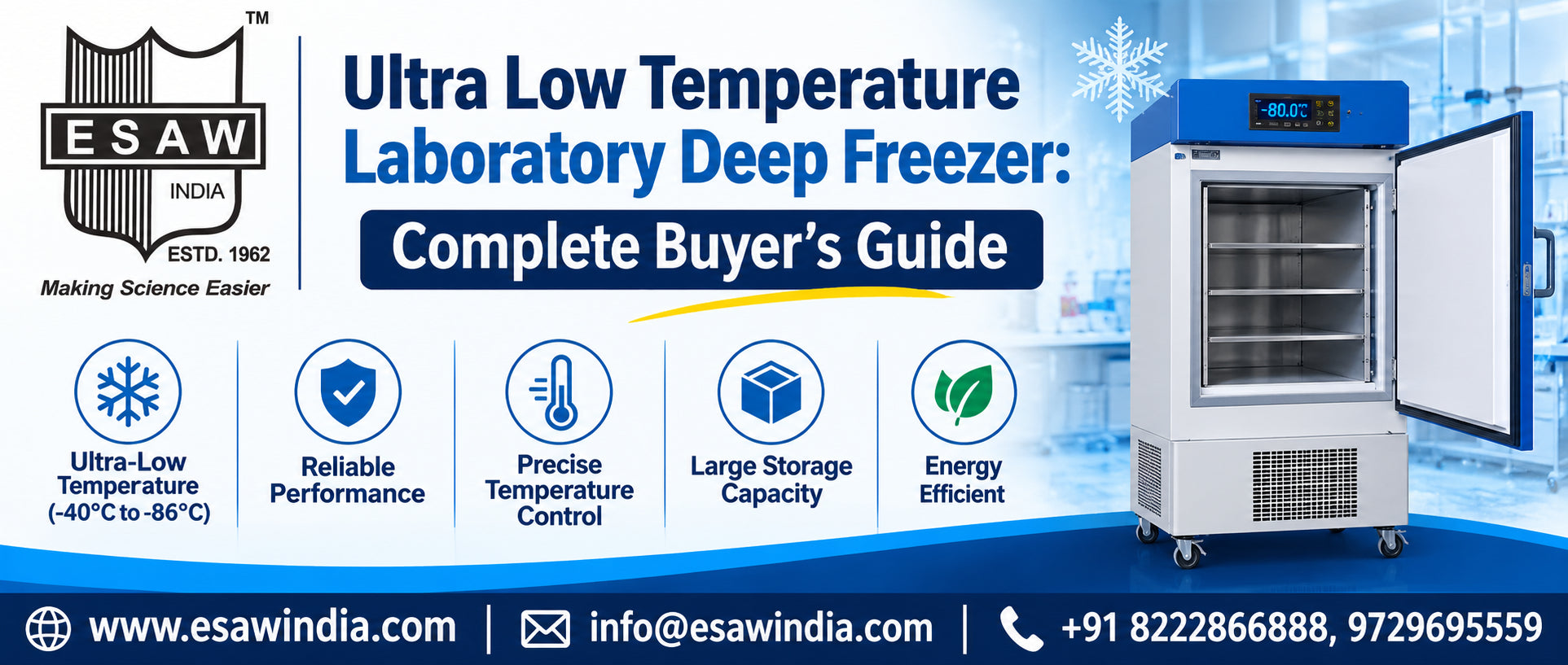
Ultra Low Temperature Laboratory Deep Freezer: Complete Buyer’s Guide, Technical Specifications & Pricing
by Akash Dhawan
In modern scientific research, biotechnology, pharmaceuticals, and clinical diagnostics, preserving the biological integrity of sensitive samples is non-negotiable. Standard refrigeration units simply cannot prevent cellular degradation, enzymatic activity, or DNA/RNA breakdown over extended periods. This is where an ultra low temperature laboratory deep freezer (commonly referred to as a ULT freezer) becomes the backbone of any advanced storage facility.
Operating typically within a temperature range of -40°C to -86°C (with specialized cryogenic units reaching -150°C), these engineered systems ensure that vaccines, stem cells, tissue samples, bacterial cultures, and blood plasma remain viable for years. As a trusted scientific and laboratory equipment manufacturer, ESAW India designs precision-engineered ultra-low cold storage solutions built for durability, thermal accuracy, and long-term operational reliability.
Whether you are setting up a new diagnostic center, upgrading a university research facility, or procuring equipment for a biobank, understanding the mechanics, features, and ultra low temperature deep freezer price factors is essential for making a sound capital investment.
Ready to Order or Request a Quote?
Contact ESAW India today for best pricing and customized laboratory specifications.
What is an Ultra Low Temperature Lab Deep Freezer?
An ultra low temperature lab deep freezer is a specialized cold-storage unit designed to maintain extreme sub-zero temperatures with high thermal stability and rapid temperature recovery after door openings. Unlike commercial or household freezers that rely on a single compressor, ULT freezers typically utilize a cascade refrigeration system.
How the Cascade Refrigeration System Works
To achieve temperatures down to -86°C without overworking the mechanical components, ULT freezers use two independent cooling circuits working in tandem:
- High-Stage Circuit: Absorbs heat from the low-stage circuit and rejects it into the ambient laboratory environment using standard refrigerants.
- Low-Stage Circuit: Uses specialized low-boiling-point refrigerants to extract heat directly from the insulated inner chamber, dropping the temperature to -86°C.
Modern units from ESAW India increasingly incorporate CFC- and HCFC-free eco-friendly refrigerants alongside high-precision Platinum (Pt1000) or microprocessor temperature sensors, offering superior thermodynamic efficiency, lower daily energy consumption, and compliance with global environmental standards.
Key Applications Across Industries
The demand for reliable ultra-low cold storage spans multiple high-stakes sectors:
- Biopharmaceuticals & Vaccine Storage: Essential for storing mRNA vaccines, monoclonal antibodies, active pharmaceutical ingredients (APIs), and biologics that degrade rapidly at standard freezer temperatures (-20°C).
- Clinical & Hospital Laboratories: Used for long-term archiving of blood plasma, serum, bone marrow, and diagnostic reagents.
- Academic & Molecular Biology Research: Preserves DNA, RNA, proteins, enzymes, and cell lines without structural alteration.
- Forensic & Biobanking Facilities: Maintains biological evidence and genetic samples over decades with zero cross-contamination.
- Industrial & Materials Testing: Tests the durability, brittleness, and performance of aerospace polymers, automotive components, and electronics under extreme cold stress.
Upright vs. Chest ULT Freezers: Which Should You Choose?
When evaluating an ultra low temperature laboratory deep freezer, the first structural decision involves choosing between an upright (vertical) model and a chest (horizontal) model—both of which are engineered within the ESAW India product lineup.
| Feature | Upright ULT Freezer | Chest ULT Freezer |
|---|---|---|
| Footprint & Space | Compact floor footprint; utilizes vertical space efficiently. | Requires wider floor area; needs top clearance for lid opening. |
| Sample Accessibility | Easy access via stainless-steel shelves, racks, and inner insulated doors. | Requires bending/reaching; best for long-term bulk archiving. |
| Temperature Stability | Cold air escapes faster when the main door opens (mitigated by inner doors). | Superior cold retention because cold air stays settled at the bottom. |
| Energy Consumption | Slightly higher due to vertical air exchange during frequent access. | Generally 15–20% more energy-efficient for infrequent access. |
| Best Use Case | High-throughput labs with daily sample retrieval. | Biobanks and long-term repositories with minimal door openings. |
Essential Features to Look for Before Buying
Investing in an ultra low temperature lab deep freezer requires looking beyond basic cooling capacity. High-performing models integrate redundant safety and monitoring technologies to protect irreplaceable samples:
- Vacuum Insulated Panels (VIP): VIP technology combined with high-density polyurethane foam provides superior thermal insulation while keeping wall thickness slim (≤ 7 cm)—maximizing internal storage capacity within a standard lab footprint.
- Independent Inner Doors: 2 to 5 insulated, removable inner doors minimize cold air loss when retrieving samples from a single shelf, dramatically improving temperature recovery time.
- Microprocessor Controller & Data Logging: Digital PID/microcomputer controllers with ±0.1°C display accuracy, USB data export, and RS485/Modbus connectivity for centralized Building Management Systems (BMS).
- Multi-Tiered Alarm Systems: Audible and visual alerts for high/low temperature deviations, power failure, door ajar, sensor error, condenser cleaning, and low battery backup.
- CO2 / LN2 Backup Compatibility: Optional liquid carbon dioxide or liquid nitrogen injection ports that maintain sub-zero temperatures during extended power grid failures.
- Heated Pressure Equalization Port: Prevents vacuum lock after closing the door, allowing researchers to reopen the freezer smoothly within seconds.
Why Choose ESAW India for Ultra Low Temperature Deep Freezers?
With decades of manufacturing heritage in Ambala, Haryana, ESAW India (Engineering Science Apparatus Workshop) has established itself as a trusted manufacturer and exporter of laboratory cold storage equipment.
- Diverse Capacity & Temperature Range: From compact 100L–400L horizontal chest models (such as the LDF-90 series operating at -80°C) to high-capacity 545-litre vertical cascade systems (such as the ULTLDF-545L operating down to -86°C with a 350+ cryobox capacity).
- International Quality Compliance: Manufactured in adherence to ISO, CE, and GMP standards to meet strict institutional, pharmaceutical, and export requirements.
- Energy-Efficient Engineering: Engineered with low-power-draw compressors (<10 kWh/day on select 545L models) and heavy-duty VIP insulation to reduce long-term electricity overhead.
- Pan-India Technical Support: Backed by dedicated installation guidance, calibration support, and responsive after-sales service across India.
Ultra Low Temperature Deep Freezer Price: Cost Breakdown & Influencing Factors
One of the most frequent queries during procurement revolves around the ultra low temperature deep freezer price. Because these units are precision-engineered medical and scientific instruments, pricing varies significantly based on storage volume, compressor technology, and regulatory certifications.
Estimated Ranges (Indian Market Context)
- Compact / Horizontal Chest Models (100L – 400L at -80°C)
- Mid-Size Upright Laboratory Models (300L – 500L at -86°C)
- High-Capacity Biobank Upright Models (545L – 850L+ at -86°C)
5 Factors That Impact the Final Cost
- Internal Storage Capacity (Liters & Cryobox Count): Larger chambers capable of holding 350 to 600+ standard 2-inch cryoboxes require higher-capacity cascade compressors and heavier insulation.
- Compressor & Refrigerant Architecture: Variable-speed inverter and dual-cascade compressors cost more upfront than single-stage systems, but they deliver lower temperature thresholds (-86°C) and reduce electricity bills over a 10-year lifespan.
- Interior Construction Material: Medical-grade SS 304 or SS 316 stainless steel interiors resist corrosion from condensation and chemical spills better than painted galvanized steel, influencing the price.
- Certifications & Compliance: Models certified under CE, UL, ISO 13485, or GMP undergo rigorous validation testing, adding to the base cost.
- Optional Accessories: Stainless-steel cryo-racks, sliding drawers, chart recorders, GSM/SMS remote alert modules, and voltage stabilizers add to the total landed cost.
Maintenance Best Practices to Extend Lifespan
A well-maintained ULT freezer routinely lasts 10 to 15 years. Following a strict preventive maintenance routine prevents catastrophic compressor failure:
- Clean the Condenser Filter Monthly: Dust buildup restricts airflow, forcing compressors to run hot and consume excess power.
- Inspect Door Gaskets Weekly: Wipe silicone gaskets with a soft cloth and remove ice buildup so the magnetic seal stays airtight.
- Defrost Periodically: Scrape frost from inner doors regularly and schedule a full manual defrost once or twice a year using a backup freezer.
- Maintain Ambient Room Temperature: Keep the lab environment between 15°C and 25°C with at least 15 cm of clearance around the sides and back of the unit for heat dissipation.
Global & Pan-India Distribution Network
ESAW India proudly supplies high-performance ultra low temperature laboratory deep freezers to research institutions, medical facilities, universities, and industrial sectors across all Indian states/UTs and international countries worldwide.
Supply Across All Indian States & Union Territories
Andhra Pradesh, Arunachal Pradesh, Assam, Bihar, Chhattisgarh, Goa, Gujarat, Haryana, Himachal Pradesh, Jharkhand, Karnataka, Kerala, Madhya Pradesh, Maharashtra, Manipur, Meghalaya, Mizoram, Nagaland, Odisha, Punjab, Rajasthan, Sikkim, Tamil Nadu, Telangana, Tripura, Uttar Pradesh, Uttarakhand, West Bengal, Andaman and Nicobar Islands, Chandigarh, Dadra and Nagar Haveli and Daman and Diu, Delhi, Jammu and Kashmir, Ladakh, Lakshadweep, Puducherry.
International Export Reach (Global Countries)
United States, United Kingdom, Canada, Australia, Germany, France, United Arab Emirates (UAE), Saudi Arabia, Singapore, Malaysia, South Africa, Nigeria, Kenya, Brazil, Argentina, Mexico, Bangladesh, Nepal, Sri Lanka, Vietnam, Indonesia, Philippines, Thailand, Japan, South Korea, Italy, Spain, Netherlands, Switzerland, Sweden, and over 80+ countries globally.
Frequently Asked Questions (FAQs)
1. What is the ideal temperature range of an ultra low temperature laboratory deep freezer?
An ultra low temperature laboratory deep freezer typically operates between -40°C and -86°C, with -80°C being the global standard for storing biological samples, mRNA vaccines, enzymes, and clinical reagents without cellular degradation.
2. What factors determine the ultra low temperature deep freezer price?
The ultra low temperature deep freezer price depends primarily on internal capacity (ranging from 100L to 850L+), compressor type (single-stage vs. dual-cascade), Vacuum Insulated Panel (VIP) thickness, stainless steel interior grade, and international certifications like CE, ISO, or GMP.
3. How does an ultra low temperature lab deep freezer differ from a regular commercial deep freezer?
A regular deep freezer uses a single-stage compressor to reach around -18°C to -25°C, which is suitable only for food storage. In contrast, an ultra low temperature lab deep freezer uses a dual-compressor cascade refrigeration system, heavy-duty thermal insulation, and microprocessor alarms to sustain -80°C to -86°C with tight temperature uniformity.
4. How much electricity does a -86°C ultra low temperature freezer consume per day?
Modern energy-efficient ULT freezers—such as the ESAW India 545L cascade series utilizing CFC-free refrigerants and VIP insulation—consume less than 10 kWh per day, whereas older conventional models can consume between 16 and 22 kWh daily depending on ambient room temperature and door-opening frequency.
5. What happens to samples in an ultra low temperature laboratory deep freezer during a power outage?
High-quality units feature thick polyurethane and VIP insulation that provides a slow warm-up rate (often taking 4 to 6 hours to rise from -80°C to -50°C). Additionally, many labs equip their freezers with CO2 or LN2 backup systems and uninterruptible power supplies (UPS) for continuous protection.
6. How many 2-inch cryoboxes can fit inside a standard 500–545 liter ULT freezer?
A standard 500L to 545L upright ultra low temperature lab deep freezer equipped with stainless steel inventory racks typically holds 350 or more standard 2-inch (50 mm) cryoboxes, accommodating over 35,000 individual 2 mL cryovials.
7. Why do ULT freezers have multiple inner insulated doors?
Inner insulated doors compartmentalize the storage chamber so that when a researcher opens the main outer door to retrieve a specific rack, cold air remains trapped inside the other compartments—minimizing temperature fluctuations and reducing compressor workload.
8. How often should an ultra low temperature freezer be defrosted and serviced?
Frost around the door gaskets and inner doors should be wiped away weekly, while a complete manual defrost and preventive compressor check should be performed every 6 to 12 months to maintain optimal cooling efficiency and prevent ice-related seal damage.
Related Products & Search Variations
-86 degree deep freezer price in India -80°C laboratory freezer manufacturer India ULT freezer for vaccine storage Biomedical ultra low temperature freezer Cryogenic laboratory deep freezer price Upright -86°C lab freezer supplier Cascade refrigeration system deep freezer Energy efficient ULT freezer for biobank -86°C deep freezer specifications and capacity Laboratory cold storage equipment -80°C SS 304 inner chamber ultra low freezer Horizontal chest -80°C laboratory freezer
Key Thoughts
Selecting the right ultra low temperature laboratory deep freezer is far more than a routine equipment purchase—it is a long-term safeguard for high-value biological research, clinical diagnostics, and pharmaceutical innovation. While comparing the upfront ultra low temperature deep freezer price across different capacities and configurations is important, decision-makers should equally weigh total cost of ownership, including daily energy consumption, cascade compressor reliability, Vacuum Insulated Panel efficiency, and responsive after-sales support. By partnering with an established manufacturer like ESAW India and prioritizing certified thermal stability, smart alarm redundancy, and routine preventive maintenance, any laboratory or biobank can ensure decades of uninterrupted sample protection and operational peace of mind.


Leave a comment