New customers save 5% with the code GET05

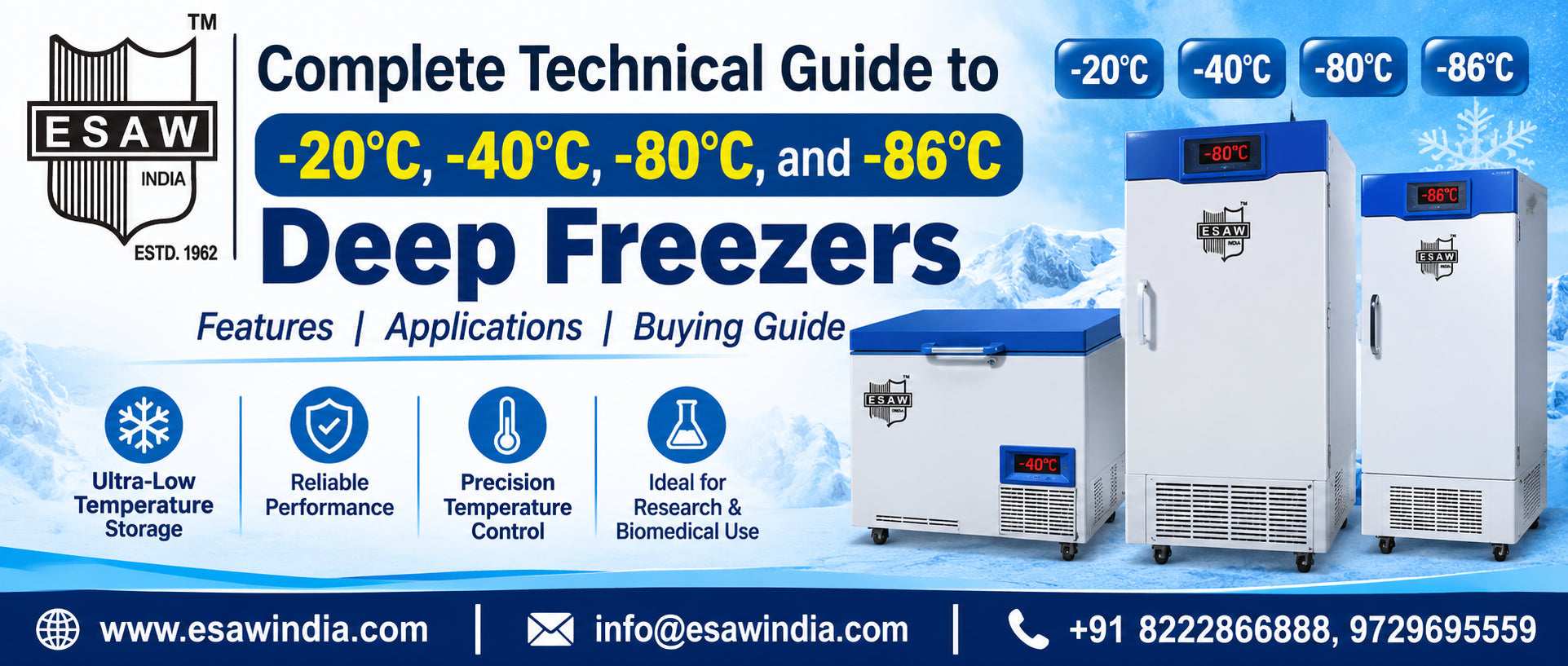
Precision Sub-Zero Cold Storage: Complete Technical Guide to -20°C, -40°C, -80°C, and -86°C Deep Freezers
Reliable cold chain integrity forms the backbone of modern scientific research, pharmaceutical manufacturing, clinical diagnostics, and industrial quality testing. When biological specimens, enzymes, mRNA vaccines, blood plasma, or volatile chemical reagents experience even minor thermal fluctuations, sample degradation can invalidate months of research or compromise patient safety.
As an established laboratory and scientific equipment manufacturer based in Ambala Cantt, Haryana, ESAW India designs and supplies heavy-duty sub-zero cold storage systems tailored for Indian ambient conditions and global laboratory standards. Our specialized range spans four critical thermal tiers: the-20°C deep freezer, -40°C deep freezer, -80°C deep freezer, and -86°C deep freezer. Each system is engineered with high-density insulation, microprocessor-based temperature controllers, and CFC-free refrigeration circuits to deliver uninterrupted thermal stability across universities, hospitals, blood banks, and biotech facilities.
Understanding Sub-Zero Temperature Tiers in Laboratory Cold Storage
Selecting the right laboratory freezer depends entirely on the molecular stability and storage duration of your materials. Standard commercial refrigeration cannot hold ultra-low setpoints or recover rapidly after frequent door openings. Laboratory-grade units solve this through specialized compressor architectures, multi-stage cascade cooling, and reinforced door gaskets.

Standard Sub-Zero
1. -20°C Deep Freezer: Daily Laboratory & Clinical Preservation
The -20°C deep freezer is the standard workhorse for routine cold storage in pathology labs, academic institutions, microbiology departments, and pharmaceutical dispensaries. Operating typically across an adjustable range of -15°C to -25°C, this unit halts bacterial proliferation and slows enzymatic activity without requiring complex two-stage cascade refrigeration.
- Core Applications: Short-to-medium-term storage of PCR reagents, restriction enzymes, diagnostic kits, serological samples, culture media, and routine pharmaceutical compounds.
- Engineering Design at ESAW India: Built with corrosion-resistant SS-304 stainless steel inner chambers and powder-coated heavy-gauge steel exteriors, ESAW India’s -20°C units utilize high-efficiency single-stage hermetic compressors paired with eco-friendly R290 or R134a refrigerants. High-density PUF (Polyurethane Foam) insulation (70 mm to 80 mm thickness) minimizes thermal bridging and keeps power consumption low even when ambient room temperatures reach 40°C+.
- Configuration Options: Available in both Vertical Upright models (with adjustable stainless steel shelves or transparent inner drawers to prevent cold-air loss) and Horizontal Chest configurations (ideal for bulk storage and minimal thermal spill during lid opening).
Plasma & Serum Grade
2. -40°C Deep Freezer: Blood Plasma & Critical Reagent Protection
When samples require deeper thermal arrest than standard freezing can provide—yet do not demand cryogenic-adjacent ultra-low temperatures—the -40°C deep freezer bridges the gap efficiently. Holding a precise temperature band between -30°C and -40°C, this system is essential for preserving delicate biological proteins and blood derivatives.
- Core Applications: Long-term preservation of Fresh Frozen Plasma (FFP) in blood banks, heat-sensitive vaccines, botanical extracts, industrial polymers, and specialized chemical reagents that undergo structural breakdown above -30°C.
- Engineering Design at ESAW India: ESAW India’s -40°C deep freezer models feature upgraded low-temperature compressors, copper cooling coils wrapped directly around the inner stainless steel liner for uniform wall conduction, and 100 mm to 120 mm high-density PUF insulation. Dual silicone rubber door gaskets prevent frost buildup around the perimeter, while a digital PID microprocessor controller maintains setpoint accuracy within ±0.5°C to ±1.0°C.
Biobanking Standard
3. -80°C Deep Freezer: Biobanking & Molecular Biology Standard
The -80°C deep freezer is the gold standard for long-term biological archiving, genomics, proteomics, and pharmaceutical R&D. At -80°C, virtually all cellular metabolism, nucleic acid degradation, and protein denaturation cease, allowing irreplaceable samples to remain viable for years.
- Core Applications: Preservation of DNA, RNA, viral vectors, monoclonal antibodies, stem cells, tissue biopsies, bacterial glycerol stocks, and clinical trial specimens.
- Engineering Design at ESAW India: Reaching and holding -80°C requires a dual-compressor cascade refrigeration system. In this architecture, a high-stage compressor cools a low-stage refrigerant loop via a brazed plate heat exchanger, enabling rapid pull-down times and steady thermal recovery after door access. ESAW India equips its -80°C series with inner insulated sub-doors (divided into 3 to 5 independent compartments) so technicians can retrieve specific cryo boxes without exposing the entire chamber to warm laboratory air.
Flagship ULT Series
4. -86°C Deep Freezer: Ultra-Low Temperature (ULT) Cryo-Preservation
Designed for the most demanding ultra-low temperature protocols, the -86°C deep freezer provides an extra thermal safety buffer below -80°C. That additional 6°C margin is critical in high-traffic research centers and vaccine distribution hubs, ensuring that even during brief door openings or minor ambient spikes, internal sample temperatures never drift above the critical -80°C threshold.
- Core Applications: Ultra-long-term mRNA vaccine storage, bone marrow and cord blood banking, forensic evidence archiving, aerospace material stress testing, and high-value biologics manufacturing.
- Engineering Design at ESAW India: ESAW India’s -86°C deep freezer represents our flagship Ultra-Low Temperature (ULT) engineering. It combines 120 mm to 150 mm composite PUF and Vacuum Insulated Panel (VIP) walls, heavy-duty cascade compressors with auto-cascade thermal balancing, heated pressure-equalization ports (allowing effortless door re-opening immediately after closure), and comprehensive audio-visual alarm suites with battery backup and RS-485/USB data logging.

Technical Comparison Matrix: Choosing the Right ESAW India Deep Freezer
| Technical Parameter | -20°C Deep Freezer | -40°C Deep Freezer | -80°C Deep Freezer | -86°C Deep Freezer |
|---|---|---|---|---|
| Operating Temperature Range | -15°C to -25°C | -30°C to -40°C | -50°C to -80°C | -40°C to -86°C |
| Refrigeration Architecture | Single-Stage Hermetic Compressor | Heavy-Duty Low-Temp Single Stage | Two-Stage Cascade System | Dual-Compressor Cascade + Sub-Cooling |
| Insulation Specification | 70–80 mm CFC-Free PUF | 100–120 mm High-Density PUF | 120–140 mm PUF + Inner Sub-Doors | 130–150 mm PUF + Vacuum Panels (VIP) |
| Inner Chamber Material | SS-304 Stainless Steel | SS-304 / SS-316 Grade Steel | SS-304 Non-Magnetic Stainless Steel | SS-304 / SS-316 GMP Grade Steel |
| Temperature Accuracy | ±1.0°C | ±1.0°C | ±0.5°C to ±1.0°C | ±0.5°C |
| Primary Sample Types | Enzymes, PCR kits, media, chemicals | Blood plasma (FFP), vaccines, sera | DNA/RNA, cells, viruses, tissues | mRNA vaccines, stem cells, biobanks |
| Available Capacities | 100L to 1200L (Vertical & Chest) | 150L to 600L (Vertical & Chest) | 150L to 800L (Vertical & Chest) | 200L to 850L (Upright ULT) |
Core Engineering Features Across ESAW India Deep Freezers
Whether a facility procures a compact -20°C deep freezer for a college teaching lab or a large-capacity -86°C deep freezer for a pharmaceutical QC department, every ESAW India unit incorporates standardized engineering safeguards:
1. Microprocessor PID Control & Real-Time Telemetry
Precision begins with accurate sensing. All ESAW India freezers feature calibrated PT-100 temperature sensors linked to a bright digital LED/LCD microprocessor controller. Operators can lock setpoints via password protection to prevent accidental parameter changes. Optional 7-day circular chart recorders and USB/RS-485 data loggers generate tamper-evident audit trails required for ISO, NABL, and WHO-GMP compliance.
2. Multi-Layer Thermal Protection & Rapid Pull-Down
Frequent sample retrieval is the leading cause of temperature excursions in busy labs. To combat thermal loss:
- Inner Compartmentalization: Upright -80°C and -86°C deep freezer include independent insulated inner doors with magnetic latches, isolating unused shelves from warm air currents.
- Triple-Layer Silicone Gaskets: Outer doors utilize multi-lip magnetic gaskets that stay flexible at ultra-low temperatures without cracking.
- Pressure Relief Valve: In ULT models, a heated vacuum-release port equalizes internal air pressure within seconds of closing the door, preventing vacuum lock and allowing immediate re-entry.
3. Comprehensive Safety & Alarm Diagnostics
Unattended overnight operation demands proactive fault detection. ESAW India integrates an intelligent alarm module powered by a rechargeable battery backup (lasting up to 48–72 hours during mains power failure) that alerts staff to:
- High or low temperature deviation beyond user-defined limits
- Door ajar status (triggered after 60 seconds)
- Power supply interruption
- Condenser filter clogging or high ambient temperature warning
- Sensor failure and low backup battery alert
4. Tropicalized Design for Indian Laboratory Environments
Many imported freezers struggle when ambient laboratory temperatures exceed 30°C due to intermittent air conditioning. ESAW India engineers its refrigeration condensers, fan motors, and compressor cooling loops specifically for tropicalized performance (up to 42°C ambient temperature), ensuring reliable pull-down and compressor longevity across diverse Indian climates.
Industry-Specific Applications of ESAW India Sub-Zero Freezers
- Pharmaceutical & Biotech R&D: Stability testing, active pharmaceutical ingredient (API) archiving, cell line banking, and enzyme storage using -40°C, -80°C, and -86°C deep freezers.
- Hospitals, Blood Banks & Diagnostic Centers: Safe storage of Fresh Frozen Plasma (FFP), cryoprecipitate, viral transport media (VTM), and diagnostic reagents in -20°C and -40°C deep freezers.
- Medical, Nursing & Agricultural Universities: Teaching and research departments rely on ESAW India’s vertical and horizontal -20°C deep freezers for storing botanical specimens, zoological samples, soil extracts, and biochemical reagents.
- Industrial & Material Testing Laboratories: Rubber, polymer, automotive, and aerospace laboratories utilize -40°C and -80°C deep freezers for sub-zero brittle point testing, thermal shock conditioning, and adhesive curing prevention.
How to Select the Right Deep Freezer for Your Facility
Before finalizing specifications for procurement or tender submission, evaluate these five operational factors:
1
Required Setpoint & Thermal Buffer: Choose a -20°C deep freezer for routine reagents, -40°C for blood plasma, -80°C for standard nucleic acid archiving, and -86°C when strict regulatory audits require an extra buffer below -80°C.
2
Upright (Vertical) vs. Chest (Horizontal) Orientation: Upright freezers maximize floor space and offer rapid rack-based inventory access. Chest freezers retain cold air better during lid openings (since cold air is denser than warm air) and suit long-term bulk archiving.
3
Internal Storage Capacity Count: Calculate capacity in both liters (e.g., 200L, 340L, 500L, 650L) and standard 2-inch capacity (ranging from 14,000 to over 45,000 2-ml cryovials in ULT models).
4
Electrical & Power Backup Readiness: All ESAW India units operate on standard 220–240V AC, 50Hz single-phase power. Pairing ULT freezers with an automatic servo voltage stabilizer and online UPS ensures uninterrupted compressor protection.
5
Compliance & Documentation: For NABL-accredited labs and GMP facilities, request IQ/OQ/PQ validation protocols, NABL-traceable calibration certificates, and integrated data logging at the time of order.


Leave a comment