Skip to content
Currency

New customers save 5% with the code GET05

🔹Image ALT Tags:

"Trinocular Polarizing Microscope with Dual Light Source for Geology Labs"

"Best Polarizing Microscope for Students and Research in India"

"Lab Microscope with Incident and Transmitted Illumination"

"Affordable Trinocular Microscope for Engineering Colleges"

Shop Trinocular Polarizing Microscope with Dual Illumination – Advanced Research Microscope

Model No : PZ-620

Regular price Rs. 795,999.00
Tax included.Shipping calculated at checkout.
Quantity:
Estimated Delivery:
Guaranteed Safe Checkout
Delivery Period

3-5 Working Days

Replacement

3 Days Replacement as standard, Free of Cost

Dedicated Support

Support from 9:30 AM to 6:00 PM everyday

Description

    Specifications

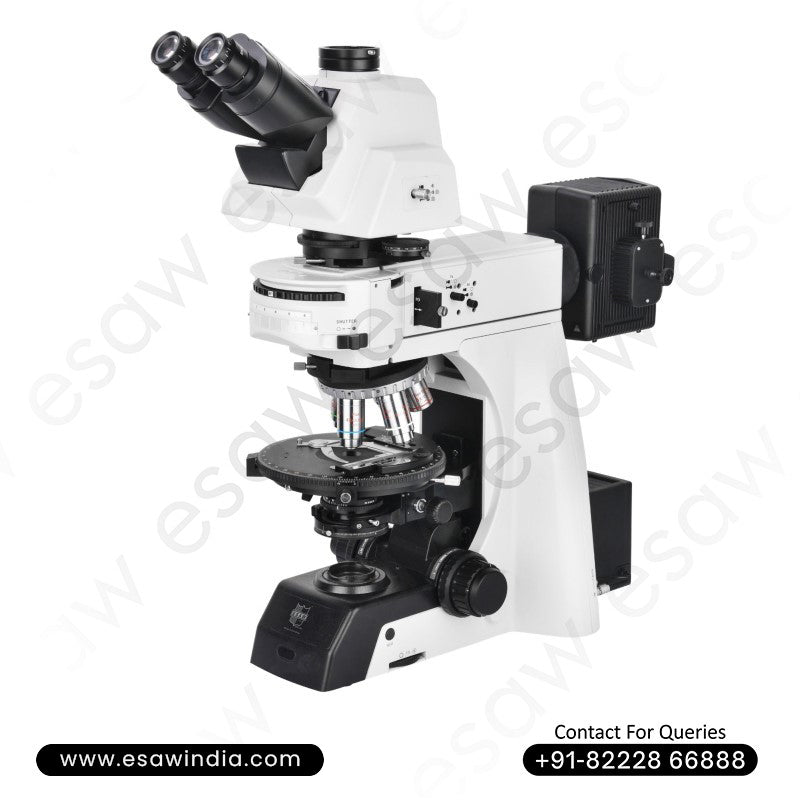
    Product Trinocular Dual Illumination Polarizing Microscope
    Head Trinocular Head 45° Inclined 360° Rotatable
    Eyepiece WF 10X & H10X
    Objective Achromatic Strain Free 4x, 10x, 40x SL
    Stage 135 mm Dia with 360° Graduated Rotation & Vernier
    Condenser Abbe N.A. 1.25 Iris Diaphragm
    Polariser 360° Rotatable under Condenser
    Analyzer Slide-in Analyzer Above Nosepiece
    Illumination 6V-20W Halogen Lamp (Incident & Transmitted)
    Catalog No. ESAW-TPDM
    Quantity Per Case 1 Unit

    Significance

    The **Trinocular Polarizing Microscope** is an indispensable analytical instrument used to examine the optical properties of **anisotropic materials**—substances like minerals, crystals, and fibers that interact differently with light depending on the polarization plane. It achieves this by using polarized light from a polarizer and passing it through the specimen to an analyzer, allowing characteristics like **birefringence, extinction angle, and pleochroism** to be quantitatively measured.

    Its significance is profound in geology, material science, and pharmaceutical analysis, where structure-property relationships are paramount. The **Trinocular port** ensures that sophisticated analysis can be digitally documented and processed, vital for research validation across international standards.

    Uses

    This microscope is a cornerstone in specialized laboratories across various sectors, particularly within India’s growing research and industrial landscape:

    • **Geology and Mineralogy:** Primary tool for identifying minerals in rock thin sections by observing their interference colours and optical axes. Used extensively in mining and exploration hubs in **Jharkhand** and **Karnataka**.
    • **Material Science:** Essential for quality control and R&D in materials like polymers, ceramics, and liquid crystals, widely employed by automotive and electronics industries.
    • **Pharmaceutical Analysis:** Used for characterizing crystalline properties of drug compounds (polymorphism), which affects dissolution and bioavailability. Critical in major pharma zones in **Gujarat** and **Telangana**.
    • **Forensics:** Examining fibers, hairs, and crystalline residues found at crime scenes, providing crucial evidence based on refractive indices and birefringence.
    • **Petroleum Engineering:** Analyzing reservoir rock structure and porosity for oil and gas exploration, necessary for energy research centers.

    Applications

    The quantitative measurement capabilities of the Polarizing Microscope are highly sought after by academic and commercial sectors. Our **Trinocular Polarizing Microscope** enables researchers to perform advanced applications reliably:

    Applications include precise determination of the **refractive index** and the identification of unknown crystalline substances. In academic institutions, from **Delhi University** to specialized research institutes in **Pune** and **Kolkata**, it serves as a vital teaching aid to demonstrate complex optical phenomena. The robust mechanical stage and highly accurate goniometer system allow for the necessary precise orientation of specimens, enabling sophisticated petrographic and materials analysis applications that are demanded both nationally and internationally.

    Product Keywords

    Trinocular Polarizing Microscope Manufacturer Mineralogy Polarizing Microscope Price Petrographic Microscope for Geology Buy Strain-Free Polarizing Objectives Research Grade Polarizing Microscope India Microscope for Birefringence Measurement Polarizer Analyzer Microscope System Rotating Stage Polarizing Microscope Pharmaceutical Polymorphism Analysis Microscope Forensic Fiber Analysis Microscope

    Frequently Asked Questions (FAQ)

    • 1. What is the role of the Compensators in this microscope? The compensators (Gypsum, Mica, Quartz Wedge) are inserted into the light path to determine the **optical sign** of a crystal (positive or negative) and to measure the degree of **birefringence** by introducing a known path difference to the polarized light.
    • 2. Why must the objectives be 'Strain-Free'? Strain-free objectives are critical because any residual stress (strain) in the objective glass itself would cause its own birefringence, which would interfere with and distort the light passing through the actual specimen, leading to incorrect measurements.
    • 3. How is the Trinocular port used in polarizing microscopy? The Trinocular port allows a camera to be attached, enabling the capture of high-resolution images and videos of interference figures and colours. This is vital for quantitative analysis using image software (e.g., measuring extinction angles) and for digital documentation in reports and research papers.
    • 4. What kind of samples are typically viewed under a Polarizing Microscope? Generally, the samples are **anisotropic** (showing double refraction). Common samples include rock thin sections, mineral powders, synthesized crystals, textile fibers, thin polymer films, and certain pharmaceutical compounds. Isotropic materials (like glass or liquids) appear dark.
    • 5. Is the Circular Rotating Stage mandatory for analysis? Yes. The **360° Rotating Stage** is essential because many key measurements (like the extinction angle) require rotating the specimen relative to the fixed polarizer and analyzer until the material appears completely dark (extinction). This rotational capability is fundamental to polarized light microscopy.

Shopping cart

Your cart is currently empty.

Continue shopping