Skip to content
Currency

New customers save 5% with the code GET05

Image ALT Tags:

"Vacuum Oven for Chemistry Lab Glassware Drying"

"ESAW India Vacuum Oven for Science and Industrial Use"

"Lab Vacuum Oven for Students and Colleges"

"Best Vacuum Oven for Drying Heat-Sensitive Materials"

Shop Vacuum Oven – Precision Drying Under Controlled Vacuum | ESAW India

Model No : VO-125

Regular price Rs. 0.00
Tax included.Shipping calculated at checkout.
capacity: 8 Ltrs.
Quantity:
Estimated Delivery:
Guaranteed Safe Checkout
Delivery Period

3-5 Working Days

Replacement

3 Days Replacement as standard, Free of Cost

Dedicated Support

Support from 9:30 AM to 6:00 PM everyday

Description

    Core Functionality: Significance, Applications, and Uses

    Significance: Gentle and Non-Oxidative Drying

    The Vacuum Oven is paramount for processing materials that are **heat-sensitive or prone to oxidation**. By drastically lowering the pressure, the boiling point of solvents is reduced (Clausius-Clapeyron relation). This allows for rapid and complete drying at temperatures significantly lower than $100^\circ\text{C}$, protecting the chemical integrity of the sample, crucial for APIs in **Gujarat and Sikkim**.

    Applications: Removing Trapped Volatiles

    Key applications involve **low-temperature drying** of delicate powders (e.g., proteins or pharmaceutical intermediates), **degassing** liquids like epoxies, silicones, and printing inks (removing trapped air bubbles that compromise structural integrity), and pre-treating samples for sensitive analytical techniques. This is essential for electronics assembly in **Pune and Bangalore**.

    Uses: High-Tech Industry and Research

    The oven is indispensable in **Pharmaceutical Quality Control** (moisture content determination), **Aerospace** (curing/bonding of high-strength composites), **Micro-electronics** (cleaning and drying printed circuit boards), and **University Research Labs** across states like **Maharashtra, Tamil Nadu, and Delhi**.

    Technical Description: Features for Ultimate Vacuum and Safety

    Design Principles for Vacuum and Thermal Integrity

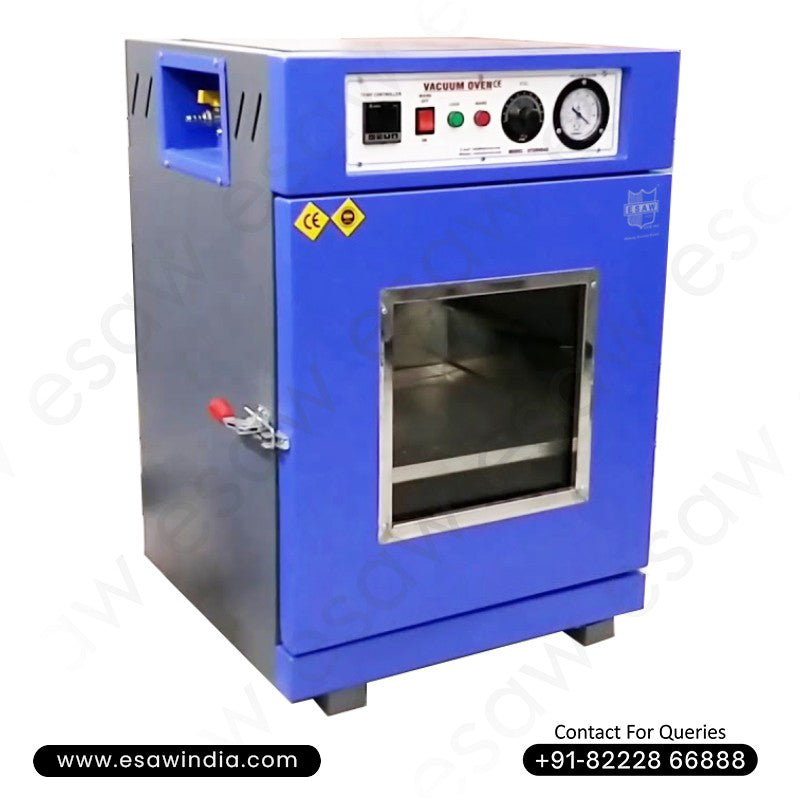
    Medico's **Vacuum Ovens** are meticulously engineered chambers built to maintain high vacuum levels while providing precise thermal control. The chamber construction is robust, featuring highly polished, corrosion-resistant stainless steel, often with a double-walled structure to ensure structural stability under high vacuum. A thick, tempered glass viewing window is fitted within a heavy door, secured by a reliable, positive-sealing latch mechanism.

    Unlike conventional ovens, heat transfer primarily occurs via **conduction** from the heated shelves directly to the sample containers, as air convection is non-existent in a vacuum. This design ensures maximum thermal efficiency. Features include an inert gas purging port for eliminating oxygen before operation, precise digital PID temperature control, and a vacuum relief valve for safety. We provide models tailored to lab and production scale, ensuring quality and performance for clients across **Karnataka, Haryana, and West Bengal**.

    • Vacuum Drying Oven
    • Low-Pressure Heating Chamber
    • Degassing Chamber Price
    • Vacuum Desiccator with Heat
    • Heat Sensitive Material Drying

    Global Supply for Scientific and Industrial Vacuum Equipment

    • India (All States)
    • USA
    • Germany
    • UK
    • Canada
    • France
    • Japan
    • South Korea
    • China
    • Australia
    • Brazil
    • Mexico
    • UAE
    • Saudi Arabia
    • Nigeria

    Related Thermal Equipment and Essential Categories

    Frequently Asked Questions (FAQ)

    1. Can I use a regular water bath vacuum pump with a vacuum oven?

    No. A standard water bath vacuum pump typically cannot achieve the deep vacuum levels (e.g., 1 Torr or lower) required for effective low-temperature drying. A specialized **chemical-resistant diaphragm or rotary vane pump** is necessary for optimal performance and to handle solvent vapors.

    2. Why is it important to purge the oven with inert gas (e.g., Nitrogen)?

    Purging the oven with an inert gas before drawing a vacuum is critical for two reasons: **Safety** (it removes oxygen, preventing fire/explosion when drying flammable solvents) and **Sample Protection** (it prevents oxidation or degradation of the sample at elevated temperatures).

    3. What safety features are built into Medico Vacuum Ovens?

    Safety features include a **shatter-resistant, tempered glass viewing window**, a **spring-loaded safety valve** to prevent over-pressurization during gas back-fill, and high-quality vacuum gaskets and door latches to maintain chamber integrity under high vacuum.

    4. Why do the shelves heat instead of the oven walls?

    In a vacuum, air molecules are too sparse to efficiently transfer heat through convection. Therefore, heat must be transferred directly to the sample containers via **conduction** from the heated metal shelves to ensure uniform and efficient heating, bypassing the need for air movement.

Shopping cart

Your cart is currently empty.

Continue shopping