New customers save 5% with the code GET05


Comparison Matrix: Top 10 Common Laboratory Glassware Manufacturers and Suppliers
by Akash Dhawan
In modern scientific research, biotech innovations, pharmaceutical quality control, and academic testing across the United States, experimental accuracy relies on top-quality equipment. Behind every ground-breaking chemical synthesis or routine liquid assay lies a foundation of high-grade borosilicate scientific apparatus. Choosing the right supplier is essential for worker safety, chemical purity, and long-term durability.
This comprehensive guide covers the top 10 common laboratory glassware items, why material standards matter under US regulations, and the premier USA-based manufacturers and suppliers serving the global market today.
Why Glassware Quality Matters in Scientific Research
Not all glass is suitable for laboratory environments. Standard soda-lime glass cannot withstand the harsh thermal shifts, chemical corrosion, and vacuum pressures typical of industrial and academic research.
Key Characteristics of Premium Laboratory Glassware:
- High Thermal Shock Resistance: Premium 3.3 expansion borosilicate glass has a low coefficient of thermal expansion, permitting direct flame heating and rapid autoclaving without structural cracking.
- Chemical Inertness: Superior labware resists leaching when exposed to aggressive acids, organic solvents, and neutral solutions, safeguarding sample purity.
- Class A Calibration Standards: Volumetric glassware must conform to strict ASTM E287, E694, and E542 standards for accurate volume measurement and delivery during titrations.
- Uniform Wall Construction: Stress-free annealing prevents weak points during vacuum distillation or pressure-driven procedures.
Top 10 Common Laboratory Glassware Items
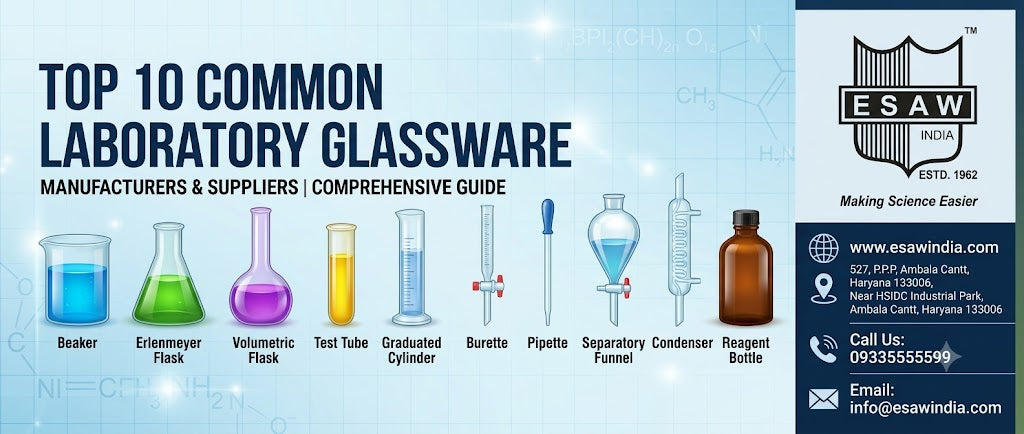
Here is an overview of the 10 most indispensable glassware items essential to every modern laboratory:
  Top 10 Laboratory Glassware Essentials
  │
  ├── 1. Beakers (Low Form & Tall Form)
  ├── 2. Erlenmeyer (Conical) Flasks
  ├── 3. Volumetric Flasks
  ├── 4. Graduated Cylinders
  ├── 5. Test Tubes & Boiling Tubes
  ├── 6. Burettes with PTFE Stopcocks
  ├── 7. Pipettes (Volumetric & Graduated)
  ├── 8. Separatory Funnels
  ├── 9. Glass Condensers
  └── 10. Reagent & Media Bottles
1. Beakers (Low Form & Tall Form)
Beakers are cylindrical containers used for mixing, stirring, and heating liquids. Griffin low-form and Berzelius tall-form beakers feature heavy-duty rims and precision pouring spouts.
2. Erlenmeyer (Conical) Flasks
Featuring a flat base, conical body, and narrow neck, Erlenmeyer flasks allow liquid swirling and mixing without splashing. They are ideal for titrations, cell cultures, and media heating.
3. Volumetric Flasks
Calibrated to hold precise volumes at set temperatures, volumetric flasks are required for preparing exact standard solutions. They come in Class A (analytical reference) and Class B (routine qualitative) tolerances.
4. Graduated Cylinders
Designed for everyday liquid volume measurements with higher accuracy than beakers. They feature heavy hexagonal or round bases for tip resistance.
5. Test Tubes & Boiling Tubes
Slender cylindrical vessels open at the top, used for qualitative chemical tests, small reactions, and heat-testing over direct burner flames.
6. Burettes (Class A Precision)
Long, graduated glass tubes with precision PTFE or glass stopcocks at the bottom. Essential for quantitative volumetric analysis and chemical titrations.
7. Pipettes (Volumetric & Graduated)
Used to measure and transfer exact fluid volumes. Volumetric pipettes deliver fixed volumes, while Mohr/serological pipettes offer adjustable, multi-mark fluid transfer.
8. Separatory Funnels
Pear-shaped or conical funnels used in liquid-liquid extraction to separate immiscible liquids of differing densities (such as organic solvents and water).
9. Glass Condensers (Liebig, Allihn, Graham)
Dual-chambered units that condense hot vapors back into liquids during reflux or distillation processes, equipped with standardized ground glass joints.
10. Reagent & Media Bottles
Designed for secure storage, preservation, and transport of volatile chemicals and culture media. Available in clear or amber-tinted borosilicate to protect light-sensitive reagents.
Comparison Matrix: Common Laboratory Glassware
| Glassware Type | Primary Function | Primary Standard Material | Key Precision/Feature |
|---|---|---|---|
| Beaker | Mixing, heating, holding liquids | Borosilicate 3.3 | Pouring spout for clean transfer |
| Erlenmeyer Flask | Titration, liquid swirling | Borosilicate 3.3 | Conical neck to prevent spills |
| Volumetric Flask | Analytical solution preparation | Borosilicate 3.3 | Class A single graduation mark |
| Burette | Quantitative fluid delivery | Borosilicate 3.3 / Amber | PTFE precision stopcock |
| Separatory Funnel | Liquid-liquid phase separation | Borosilicate 3.3 | Ground stopper & drainage tap |
THE ENGINEERING SCIENCE APPARATUS WORKSHOP popularly known as ESAW INDIA was started about 55 years ago. Starting on a small scope manufacturing microscopes, ESAW has grown into a well-known name across physics, laboratory glassware, electronics, and scientific instruments.
Our commitment to quality drives us to perfection. Continuous innovation, coupled with a keen understanding of consumer needs, makes us a leading company in India.
Here are some of the world's most recognized Top 10 Common Laboratory Glassware Manufacturers Suppliers and distributors of technical and volumetric glass:
1. Corning Incorporated (Pyrex®)
- Headquarters: Corning, New York
- Key Brands: Pyrex®, Vycor®
- Overview: With over 170 years of innovation, Corning is the gold standard in scientific glassware. Its Pyrex® line of 3.3 borosilicate glass is universally trusted for thermal shock resistance and mechanical strength.
2. DWK Life Sciences (Kimble®)
- Headquarters: Millville, New Jersey (US Operations)
- Key Brands: Kimble®, Wheaton®, Duran®
- Overview: DWK Life Sciences brings together historic brands like Kimble® and Wheaton® to produce high-precision volumetric glassware, vials, and specialized pharmaceutical containers.
3. Ace Glass Incorporated
- Headquarters: Vineland, New Jersey
- Overview: Founded in 1936, Ace Glass specializes in custom borosilicate scientific glassware, pilot plant reaction systems up to 200 liters, and unique heavy-duty lab accessories.
4. Chemglass Life Sciences
- Headquarters: Vineland, New Jersey
- Overview: Chemglass is a leading USA manufacturer catering to organic chemistry, bioprocessing, and pharmaceutical R&D, producing specialized reactors and custom distillation assemblies.
5. Thermo Fisher Scientific
- Headquarters: Waltham, Massachusetts
- Overview: Thermo Fisher supplies an extensive range of ASTM and ISO-compliant laboratory glass products across educational, medical, and industrial sectors.
6. Avantor (VWR)
- Headquarters: Radnor, Pennsylvania
- Overview: VWR operates one of the largest distribution networks in North America, supplying major brand-name glassware along with their own VWR Collection labware line.
7. Quartz Scientific, Inc. (QSI)
- Headquarters: Fairport Harbor, Ohio
- Overview: QSI specializes in high-purity quartz laboratory glassware (crucibles, beaker vessels, ground joints) designed for cleanroom processes and temperatures exceeding 1000°C.
8. Eisco Scientific
- Headquarters: Honeoye Falls, New York
- Overview: Eisco is a key provider of educational and academic lab apparatus, supplying durable borosilicate 3.3 glassware to schools, colleges, and research institutions.
9. Specialty Glass Products
- Headquarters: Willow Grove, Pennsylvania
- Overview: Known for precision machining, custom glass fabrication, and specialty optical components engineered for aerospace, medical, and industrial testing.
10. Wilmad-LabGlass (SP)
- Headquarters: Vineland, New Jersey
- Overview: Wilmad-LabGlass is a global leader in precision NMR and EPR spectroscopy sample tubes along with specialized research glassware.
Frequently Asked Questions (FAQs)
1. What are the dominant lab glassware brands in the USA?
The most widely used and recognized brands in US laboratories are Corning's Pyrex® and DWK Life Sciences' Kimble®.
2. Why is Borosilicate 3.3 glass preferred over standard soda-lime glass?
Borosilicate glass contains boron trioxide, giving it an extremely low coefficient of thermal expansion. This ensures high thermal shock resistance, preventing breakage during rapid heating or cooling cycles.
3. What is the difference between Class A and Class B volumetric glassware?
Class A glassware provides higher calibration accuracy with tighter tolerance limits, making it mandatory for analytical chemistry and pharmaceutical testing. Class B has double the tolerance limit and is suitable for general education.
4. Can US manufacturers produce custom-designed glassware?
Yes, American companies like Ace Glass, Chemglass, and Specialty Glass Products offer custom fabrication for proprietary reactors and specialized research setups.

Leave a comment